

Five Minutes With Violeta Ayala: Embodied AI, Indigenous Movement, and Data Sovereignty
Creating infrastructure for embodied intelligence through community-governed movement datasets, open-source tools, and governance frameworks that other communities can build on.
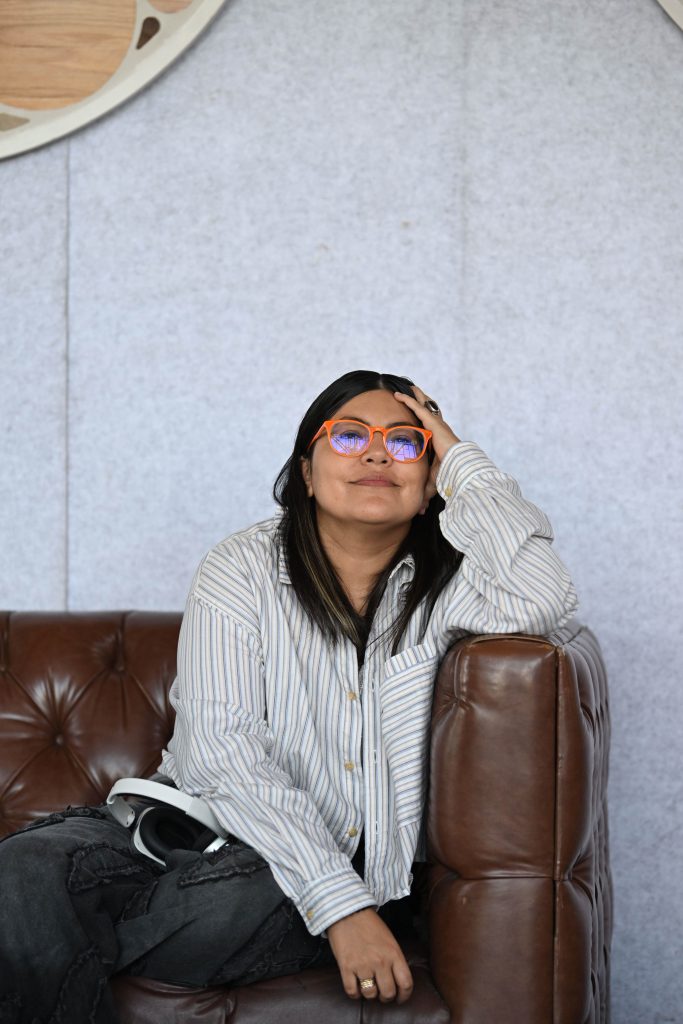
Violeta Ayala is Lead Creative Technologist and Quechua Storyteller, Systems Builder for the Abundant Intelligences funded research project, Huk.
Tell us a bit about yourself and your background.
My name is Violeta Ayala, and I’m from Cochabamba, Bolivia, a city in the middle of Bolivia, in the middle of the mountains. I’m a filmmaker and technologist. I think a film is also a system, so I like to create systems and build systems. I belong to the oldest people who once inhabited this land. I can trace back my maternal line all the way to the Bering Strait, where my ancestors crossed more than 26,000 years ago. Culturally, I’m Quechua, but ancestrally, I belong to the oldest people, even before the Quechuas arrived to this land, to the first people. I went to school in Cochabamba. I went to university in Sydney, Australia. My father was politically exiled during the dictatorships, and that’s how I ended up in Australia. My grandfather was an Indigenous leader, one of the founders of the Confederación de Trabajadores Campesinos de Bolivia. He fought for a very long time and spent more than 10 years in prison during Plan Cóndor. I belong to this very old line of fighters.
I’ve been making films for a very long time, and I’m the only Bolivian director who is a member of the Oscars. During COVID, everything changed. I felt trapped in Australia; I couldn’t come back. I felt everything was changing so fast, and I started creating in 3D. I created Prison X, the beginning of the neo-Andean world. During that time, I became interested in artificial intelligence and technology. I started learning Python as an extra language, and I realized I was fascinated by creating systems. I went from being just a filmmaker to much more of a creative technologist. When I came back home to Bolivia, the first thing I did was go to my grandmother’s town and my grandfather’s town, and I wanted to reconstruct them. GPT-3 had just come out, and it was like a puzzle. I started writing about their towns and their features because I wanted to reconstruct my grandmother, my great-great-grandmothers, and my ancestral grandmothers. I did a series called Las Awichas. It came from this very early time, when OpenAI was OpenAI and it wasn’t ChatGPT yet. They gave me credits and shared the project on their networks, and I had an exhibition in Cochabamba just after COVID. I was scared everyone would ask, “Are they real or not real?” They looked like photographs. At the time, even when I said these are not real, no one believed they were not real. Everybody was 100% sure they were real.
From that, I ended up exhibiting the same grandmothers in London. I was invited to exhibit at King’s College with women technologists, and I created 3D robotic animals that came out of their hearts. Each grandmother had her own animal, and the animals were inspired by the Nazca Lines, except the llama. The llama had to be there because the llama is from Bolivia; for me, it’s one of the animals that is very traditional to us. I had to learn to code that in Java. Las Awichas was exhibited in London and then in China, and it went to many places. One thing led to the another, and then I wanted to make a robot. I applied to Mila with Eilif Mueller and that program. One thing led to the other, and I ended up creating Huk, the robot jaguar.
Tell us about your project with Abundant Intelligences.
At first, I wanted to do a real robot, a physical robot, but it wasn’t long enough. I ended up making a digital robot that would behave like a physical robot. I realized that if you make a digital robot with the same rules as a real robot, then you could animate anything that is 3D. I understood 3D from Prison X, and then I gave the brain and created the whole world. Then I realized that I can animate anything. This is revolutionary for democratizing the animation industry. I don’t even need a mocap suit. If I want better data, of course, but everything is data, and everything is data that can be used, consumed, and misused too. At Mila, I started understanding the power of data. I learned to use terminal, build AI systems, understand weights and biases, and build an AI system from scratch. I started creating intelligence for Huk, and now I have created intelligence for eight animals and a lot of plants and flowers. I’ve been working for 13 weeks really solidly.
I am creating interactive intelligence with colours and all of these animals I had from before, but now they have become bigger because each of them has their own intelligence. The project is more about embodied intelligence. I believe intelligence cannot just be whatever we’re writing in an LLM. My interest crossed over with Elif Muller’s interest in embodied intelligence. I want to train more-than-human intelligence and think about what it means to co-create with a community, but also to record data that is not the person’s data. It is the interaction with this 3D creature. I don’t record the person; I record the creature interacting with you and learning the movements of a person. I’m creating those systems at the moment. We’re also working in Resonite and VR because we want it to be modular. When you look at patterns, you realize I’m creating quadrupeds, bipeds, octopodes, a whale, a fish, and different flowers. Those patterns could be used in anything that has those shapes. For me, the human is still very present in the loop. It’s not about taking the human out of the loop, but about how we can co-create systems that are more dignified for humans and less extractive. I even trained my own little neural net. It’s all about experimenting and playing.
I’m Quechua, and I’m working with an Aymara colleague from La Paz, from El Alto, and another colleague who is Aymara and Quechua. For me, experimentation is at the top of it, but with ethics and with a big knowledge of local AIs. At the moment, I’m using local AIs. We haven’t fine-tuned one AI yet, but we are using Qwen, Gemma, and local AIs. We are doing this in a sustainable way. I still use Claude to code because it’s complex coding.
Can you tell me about the award that you recently won and what it was for exactly?
It’s a fellowship. It’s the Mozilla Fellowship, Track 2. First, I was surprised that I was nominated, then I was surprised that I was a finalist, then I was even more surprised that I won. Most of the others (five fellows) work with certain organizations, and the other five, we are self-guided. I am guiding my own work forward for that year. They say it is for technologists who are well-recognized and already have a good track record. One thing that helped me, because I don’t have many publications, is that Eilif asked me to do epics every week for the work I’m doing with Huk. I didn’t know what to give them, so I made a PDF with all the epics as proof that I could write in a technical way. They loved them and want me to keep going with those epics. The project I’m working on with them is called Paqarina. It has to do with our traditional dances, breaking and creating neo-Andean characters. We will collect this data, but we’ll do data sovereignty, and we will work on governance: how we’re going to govern this amongst our community. We will make the process and the system public, but not the data.
It’s one year of this fellowship. I asked if the characters could also be animals, and they said, of course, whatever you create. Our dances are very tied to animals. One of the dances is called Suri Sikuri, with the ostrich from the Andes, and another is Kullawada. They are more humanoid, but they are still tied to animals. We are also going to make four shows and show our community what we’re creating, with the dancers and the AI of the dancers that will be created. They will dance with their own AIs in 3D and create at the same time. The fellowship starts on June 1st. I have to go to Mexico around the 17th or 20th of July to officially receive it. The fellowship is $100,000 for me and $25,000 for the project. It’s an honour.
Who is the fellowship affiliated with?
Mozilla Firefox. They do this every year, or they change their structures. I think they now have an affiliation with Mila too. It’s granted to me for the research and the work that I’m doing. I also have to do talks with them, and I was commissioned for the Mozilla Festival in Barcelona in October. That is not public yet. They didn’t know I got the fellowship, so the commission had nothing to do with it. For Barcelona, I think I’m going to show one of the Huk’s World creatures, maybe the whale, because it changes colours. We can record the interaction, not the person, and analyze it after. During the event, the whale will see the colour of your shirt, and her skin will change to match it. It’s all related to embodied intelligence, animation, movement, affective computing, interactive computing, and interactive intelligence. Everything we have at the moment is so extractive. If you write to ChatGPT or Claude, you have to wait until they finish, and then you give your idea. I’m trying to work in a way where we can have a much more real interaction with these AIs. How can we create different AIs that can express without words? Whales don’t speak. Plants don’t speak. How can we give these things intelligence that is more-than-human, where not everything has to be done by speaking? There are many things we understand with our bodies. Intelligence is such a misguided word. Dancers in Bolivia have ancestral intelligence, and movement has intelligence. People have communication intelligence, kinetic intelligence, intelligence with food, intelligence with plants. To say that only the ones who write are intelligent makes intelligence so small. For me, to give intelligence to more-than-human or non-human animals, I made sure they are robotic. I never wanted to make them real, because that is what Disney has done, and I believe is a disservice to real animals. They have the Nazca Lines in their bodies, but they are still robotic. I don’t want them to look real.
What are you most excited about with your new project, Huk?
I really love experimentation. I’m excited about the things I don’t know that I will end up finding out through this process. I’m most excited about the unknown. I don’t have anything to prove. If you go into projects like this having to prove something, you might not find what you wanted to prove, and then you’re going to try to prove something you didn’t have to prove to begin with. I’m most excited about the process of experimentation and community cooperation. I am also excited about sharing with the community the value of data. I don’t think there is understanding anywhere in the world of how valuable data is, or how it will define the future. I’m excited to show the dancers that I’m not going to capture your image. I’m not interested. I’m going to capture the data of your image, how they react, what they think, and how they feel about it.
I don’t think tech bros and big corporations have the right to define what the future will be. The only way we can fight for a fairer future is if we understand the tools, the techniques, and how AI is made with weights and biases, and we create alternatives. We’re small people. We’re not big. But if we create a way, others will come and create over what we create. I don’t think we can be selfish like in the past. We can be cautious with our data, but we cannot be selfish with our processes. I don’t need to share my data, but I can share the processes. Every week, with the epics, I’m sharing everything about my process: everything that works and things that don’t work. I realized I had 179 pages written. It has to become something simpler. I have to be able to make a simple cookbook that others can use to co-create within other communities, to preserve our own way of thinking and our own way of looking into the world.
In Bolivia, we have no resources to preserve Spanish; Spanish will be preserved by Spain, Mexico, and Latin America. What Bolivia has very strongly is this relationship with animals, Mother Earth, and agriculture. We can build an AI that is very strong in agriculture and preserves our own ways, but not our data. The data will be put in communities, and we will find a way to govern this data. If someone like Google wants to buy it, then maybe all the money can go to a common fund that keeps funding these types of projects. We don’t know yet. We have to decide together. Let’s try to create a way of community governance. I don’t even want to use the word democratic, because democratic is also an imposition, but we can all have a voice. If this can be replicated, we can create AIs for the land, for communities, for water. We can grow potatoes and quinoa and vegetables on top of the mountain. My family has a farm where we grow tomatoes and potatoes in the mountains. If we can gather that data and create AIs and robotics to support people from the land, then they will help us survive this technological revolution, and maybe our language could survive for real. There are many things that are misleading about Indigenous communities. We are so different from one community to another. I was talking with people in my community about robotics, and they said, but you’re not coming to teach us anything. I said, no. A lot of research has come to take information from us and teach us things. I don’t want to teach you anything; I respect your work and I want to understand if I can be of any help. They said they want their children to study agricultural robotics; they don’t want the children to leave. If we can open possibilities, for me, this is what I’m more excited about: opening possibilities. In the past, I used to dislike myself, thinking I put a lot of seeds everywhere and then I just made one tree. Today, I am 48 years old, and I came to understand that I am a seeder. That’s my role in life: to spread my seeds everywhere and think what we can do.
Abundant Intelligence helped me stay home for one year and work at home. In the beginning, it was hard because I’m a nomad and I’ve lived all over the world. But I had the possibility of creating in a way I didn’t have before, because I was always too busy travelling, talking at festivals, talking here, talking there. It was very distracting. It gave me the possibility to sit down, work at home, create a little creative computational creativity lab, and just focus on creation. When I made films or VR experiences like Prison X, I had to produce a film, a 3D experience, a VR experience. Now I am creating a world, but it gave me the opportunity to think about what I’m creating without thinking I have to produce this or that. This is coming to an end because with Mozilla I have to travel. I have to go to Mexico, Barcelona, and talk to governments. I’m going back to my past life, maybe with a different hat as a technologist, showing my work, talking, sharing, and making it public.
What I thank Abundant Intelligence for is that it gave me the possibility to hide myself a little, to be more contained, and to have this year to discover, create, and experiment without the pressure of being public. When you do the work I do, you always have to move and talk, and that’s part of how money comes to you. This was the most precious thing: giving me a little nest. This is the word: nest.
I appreciate you for sharing all of your amazing…everything. You’re doing so much. It’s good to hear it all. Thank you for sitting down with us.
By:
Jill Kinaschuk
Date:
August 24, 2026
Location:
Bolivia
Five Minutes With Violeta Ayala: Embodied AI, Indigenous Movement, and Data Sovereignty
By:
Jill Kinaschuk
Date:
August 24, 2026
Location:
Bolivia
Creating infrastructure for embodied intelligence through community-governed movement datasets, open-source tools, and governance frameworks that other communities can build on.
Violeta Ayala is Lead Creative Technologist and Quechua Storyteller, Systems Builder for the Abundant Intelligences funded research project, Huk.
Tell us a bit about yourself and your background.
My name is Violeta Ayala, and I’m from Cochabamba, Bolivia, a city in the middle of Bolivia, in the middle of the mountains. I’m a filmmaker and technologist. I think a film is also a system, so I like to create systems and build systems. I belong to the oldest people who once inhabited this land. I can trace back my maternal line all the way to the Bering Strait, where my ancestors crossed more than 26,000 years ago. Culturally, I’m Quechua, but ancestrally, I belong to the oldest people, even before the Quechuas arrived to this land, to the first people. I went to school in Cochabamba. I went to university in Sydney, Australia. My father was politically exiled during the dictatorships, and that’s how I ended up in Australia. My grandfather was an Indigenous leader, one of the founders of the Confederación de Trabajadores Campesinos de Bolivia. He fought for a very long time and spent more than 10 years in prison during Plan Cóndor. I belong to this very old line of fighters.
I’ve been making films for a very long time, and I’m the only Bolivian director who is a member of the Oscars. During COVID, everything changed. I felt trapped in Australia; I couldn’t come back. I felt everything was changing so fast, and I started creating in 3D. I created Prison X, the beginning of the neo-Andean world. During that time, I became interested in artificial intelligence and technology. I started learning Python as an extra language, and I realized I was fascinated by creating systems. I went from being just a filmmaker to much more of a creative technologist. When I came back home to Bolivia, the first thing I did was go to my grandmother’s town and my grandfather’s town, and I wanted to reconstruct them. GPT-3 had just come out, and it was like a puzzle. I started writing about their towns and their features because I wanted to reconstruct my grandmother, my great-great-grandmothers, and my ancestral grandmothers. I did a series called Las Awichas. It came from this very early time, when OpenAI was OpenAI and it wasn’t ChatGPT yet. They gave me credits and shared the project on their networks, and I had an exhibition in Cochabamba just after COVID. I was scared everyone would ask, “Are they real or not real?” They looked like photographs. At the time, even when I said these are not real, no one believed they were not real. Everybody was 100% sure they were real.
From that, I ended up exhibiting the same grandmothers in London. I was invited to exhibit at King’s College with women technologists, and I created 3D robotic animals that came out of their hearts. Each grandmother had her own animal, and the animals were inspired by the Nazca Lines, except the llama. The llama had to be there because the llama is from Bolivia; for me, it’s one of the animals that is very traditional to us. I had to learn to code that in Java. Las Awichas was exhibited in London and then in China, and it went to many places. One thing led to the another, and then I wanted to make a robot. I applied to Mila with Eilif Mueller and that program. One thing led to the other, and I ended up creating Huk, the robot jaguar.
Tell us about your project with Abundant Intelligences.
At first, I wanted to do a real robot, a physical robot, but it wasn’t long enough. I ended up making a digital robot that would behave like a physical robot. I realized that if you make a digital robot with the same rules as a real robot, then you could animate anything that is 3D. I understood 3D from Prison X, and then I gave the brain and created the whole world. Then I realized that I can animate anything. This is revolutionary for democratizing the animation industry. I don’t even need a mocap suit. If I want better data, of course, but everything is data, and everything is data that can be used, consumed, and misused too. At Mila, I started understanding the power of data. I learned to use terminal, build AI systems, understand weights and biases, and build an AI system from scratch. I started creating intelligence for Huk, and now I have created intelligence for eight animals and a lot of plants and flowers. I’ve been working for 13 weeks really solidly.
I am creating interactive intelligence with colours and all of these animals I had from before, but now they have become bigger because each of them has their own intelligence. The project is more about embodied intelligence. I believe intelligence cannot just be whatever we’re writing in an LLM. My interest crossed over with Elif Muller’s interest in embodied intelligence. I want to train more-than-human intelligence and think about what it means to co-create with a community, but also to record data that is not the person’s data. It is the interaction with this 3D creature. I don’t record the person; I record the creature interacting with you and learning the movements of a person. I’m creating those systems at the moment. We’re also working in Resonite and VR because we want it to be modular. When you look at patterns, you realize I’m creating quadrupeds, bipeds, octopodes, a whale, a fish, and different flowers. Those patterns could be used in anything that has those shapes. For me, the human is still very present in the loop. It’s not about taking the human out of the loop, but about how we can co-create systems that are more dignified for humans and less extractive. I even trained my own little neural net. It’s all about experimenting and playing.
I’m Quechua, and I’m working with an Aymara colleague from La Paz, from El Alto, and another colleague who is Aymara and Quechua. For me, experimentation is at the top of it, but with ethics and with a big knowledge of local AIs. At the moment, I’m using local AIs. We haven’t fine-tuned one AI yet, but we are using Qwen, Gemma, and local AIs. We are doing this in a sustainable way. I still use Claude to code because it’s complex coding.
Can you tell me about the award that you recently won and what it was for exactly?
It’s a fellowship. It’s the Mozilla Fellowship, Track 2. First, I was surprised that I was nominated, then I was surprised that I was a finalist, then I was even more surprised that I won. Most of the others (five fellows) work with certain organizations, and the other five, we are self-guided. I am guiding my own work forward for that year. They say it is for technologists who are well-recognized and already have a good track record. One thing that helped me, because I don’t have many publications, is that Eilif asked me to do epics every week for the work I’m doing with Huk. I didn’t know what to give them, so I made a PDF with all the epics as proof that I could write in a technical way. They loved them and want me to keep going with those epics. The project I’m working on with them is called Paqarina. It has to do with our traditional dances, breaking and creating neo-Andean characters. We will collect this data, but we’ll do data sovereignty, and we will work on governance: how we’re going to govern this amongst our community. We will make the process and the system public, but not the data.
It’s one year of this fellowship. I asked if the characters could also be animals, and they said, of course, whatever you create. Our dances are very tied to animals. One of the dances is called Suri Sikuri, with the ostrich from the Andes, and another is Kullawada. They are more humanoid, but they are still tied to animals. We are also going to make four shows and show our community what we’re creating, with the dancers and the AI of the dancers that will be created. They will dance with their own AIs in 3D and create at the same time. The fellowship starts on June 1st. I have to go to Mexico around the 17th or 20th of July to officially receive it. The fellowship is $100,000 for me and $25,000 for the project. It’s an honour.
Who is the fellowship affiliated with?
Mozilla Firefox. They do this every year, or they change their structures. I think they now have an affiliation with Mila too. It’s granted to me for the research and the work that I’m doing. I also have to do talks with them, and I was commissioned for the Mozilla Festival in Barcelona in October. That is not public yet. They didn’t know I got the fellowship, so the commission had nothing to do with it. For Barcelona, I think I’m going to show one of the Huk’s World creatures, maybe the whale, because it changes colours. We can record the interaction, not the person, and analyze it after. During the event, the whale will see the colour of your shirt, and her skin will change to match it. It’s all related to embodied intelligence, animation, movement, affective computing, interactive computing, and interactive intelligence. Everything we have at the moment is so extractive. If you write to ChatGPT or Claude, you have to wait until they finish, and then you give your idea. I’m trying to work in a way where we can have a much more real interaction with these AIs. How can we create different AIs that can express without words? Whales don’t speak. Plants don’t speak. How can we give these things intelligence that is more-than-human, where not everything has to be done by speaking? There are many things we understand with our bodies. Intelligence is such a misguided word. Dancers in Bolivia have ancestral intelligence, and movement has intelligence. People have communication intelligence, kinetic intelligence, intelligence with food, intelligence with plants. To say that only the ones who write are intelligent makes intelligence so small. For me, to give intelligence to more-than-human or non-human animals, I made sure they are robotic. I never wanted to make them real, because that is what Disney has done, and I believe is a disservice to real animals. They have the Nazca Lines in their bodies, but they are still robotic. I don’t want them to look real.
What are you most excited about with your new project, Huk?
I really love experimentation. I’m excited about the things I don’t know that I will end up finding out through this process. I’m most excited about the unknown. I don’t have anything to prove. If you go into projects like this having to prove something, you might not find what you wanted to prove, and then you’re going to try to prove something you didn’t have to prove to begin with. I’m most excited about the process of experimentation and community cooperation. I am also excited about sharing with the community the value of data. I don’t think there is understanding anywhere in the world of how valuable data is, or how it will define the future. I’m excited to show the dancers that I’m not going to capture your image. I’m not interested. I’m going to capture the data of your image, how they react, what they think, and how they feel about it.
I don’t think tech bros and big corporations have the right to define what the future will be. The only way we can fight for a fairer future is if we understand the tools, the techniques, and how AI is made with weights and biases, and we create alternatives. We’re small people. We’re not big. But if we create a way, others will come and create over what we create. I don’t think we can be selfish like in the past. We can be cautious with our data, but we cannot be selfish with our processes. I don’t need to share my data, but I can share the processes. Every week, with the epics, I’m sharing everything about my process: everything that works and things that don’t work. I realized I had 179 pages written. It has to become something simpler. I have to be able to make a simple cookbook that others can use to co-create within other communities, to preserve our own way of thinking and our own way of looking into the world.
In Bolivia, we have no resources to preserve Spanish; Spanish will be preserved by Spain, Mexico, and Latin America. What Bolivia has very strongly is this relationship with animals, Mother Earth, and agriculture. We can build an AI that is very strong in agriculture and preserves our own ways, but not our data. The data will be put in communities, and we will find a way to govern this data. If someone like Google wants to buy it, then maybe all the money can go to a common fund that keeps funding these types of projects. We don’t know yet. We have to decide together. Let’s try to create a way of community governance. I don’t even want to use the word democratic, because democratic is also an imposition, but we can all have a voice. If this can be replicated, we can create AIs for the land, for communities, for water. We can grow potatoes and quinoa and vegetables on top of the mountain. My family has a farm where we grow tomatoes and potatoes in the mountains. If we can gather that data and create AIs and robotics to support people from the land, then they will help us survive this technological revolution, and maybe our language could survive for real. There are many things that are misleading about Indigenous communities. We are so different from one community to another. I was talking with people in my community about robotics, and they said, but you’re not coming to teach us anything. I said, no. A lot of research has come to take information from us and teach us things. I don’t want to teach you anything; I respect your work and I want to understand if I can be of any help. They said they want their children to study agricultural robotics; they don’t want the children to leave. If we can open possibilities, for me, this is what I’m more excited about: opening possibilities. In the past, I used to dislike myself, thinking I put a lot of seeds everywhere and then I just made one tree. Today, I am 48 years old, and I came to understand that I am a seeder. That’s my role in life: to spread my seeds everywhere and think what we can do.
Abundant Intelligence helped me stay home for one year and work at home. In the beginning, it was hard because I’m a nomad and I’ve lived all over the world. But I had the possibility of creating in a way I didn’t have before, because I was always too busy travelling, talking at festivals, talking here, talking there. It was very distracting. It gave me the possibility to sit down, work at home, create a little creative computational creativity lab, and just focus on creation. When I made films or VR experiences like Prison X, I had to produce a film, a 3D experience, a VR experience. Now I am creating a world, but it gave me the opportunity to think about what I’m creating without thinking I have to produce this or that. This is coming to an end because with Mozilla I have to travel. I have to go to Mexico, Barcelona, and talk to governments. I’m going back to my past life, maybe with a different hat as a technologist, showing my work, talking, sharing, and making it public.
What I thank Abundant Intelligence for is that it gave me the possibility to hide myself a little, to be more contained, and to have this year to discover, create, and experiment without the pressure of being public. When you do the work I do, you always have to move and talk, and that’s part of how money comes to you. This was the most precious thing: giving me a little nest. This is the word: nest.
I appreciate you for sharing all of your amazing…everything. You’re doing so much. It’s good to hear it all. Thank you for sitting down with us.