
Reflections from the Indigenous AI Gathering 2026: a lesson for policy-makers on “AI for All”
Indigenous community-grounded approaches to AI are embodying what “AI for All” really ought to look like.
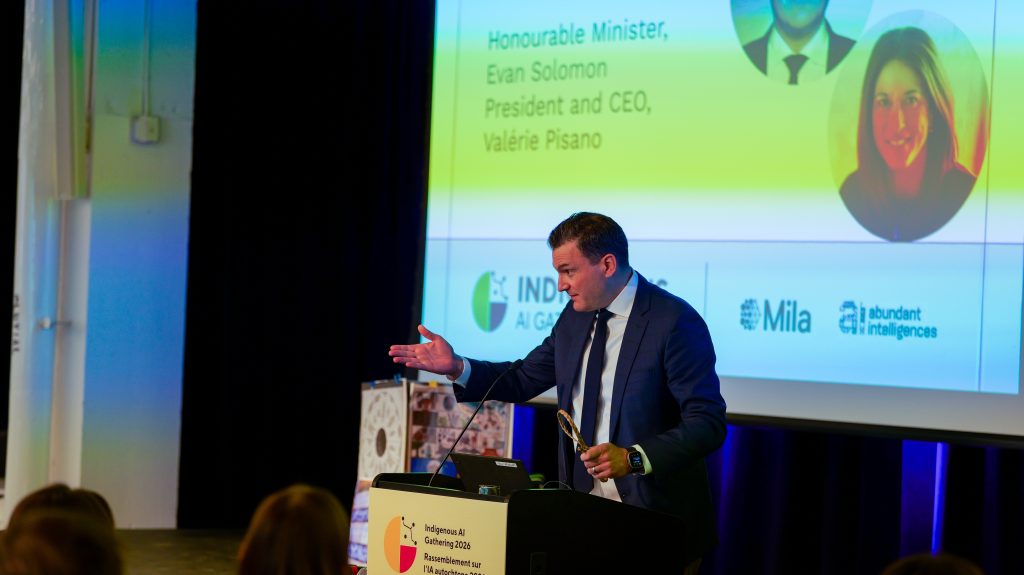
The Honourable Evan Solomon speaking at the Indigenous AI Gathering 2026 hosted by Abundant Intelligences and Mila.
Robert Marinov is a PhD candidate in Communication Studies at Concordia University. His SSHRC-funded doctoral research focuses on the emergence of “digital twinning” in Canada and its links with artificial intelligence, investigating their implications for environmental sustainability, governmentality, and democratic politics. His work has been published in journals including the Canadian Journal of Political Science, the Canadian Journal of Communication, Communication Review, Politics & Policy, Futures, Imaginaries: Journal of Cross-Cultural Image Studies, and others. Robert is a Research Assistant with Abundant Intelligences.
Having recently had the honour of being invited to the Indigenous AI Gathering 2026 held at Mila in Tiohtià:ke/Montreal, I was asked to share some of my experiences of the event as a non-Indigenous ally working with Abundant Intelligences.
The Gathering brought together Indigenous technologists, researchers, students, community members, artists, and knowledge-keepers from around the world; as well as several non-Indigenous allies to spend time sharing and learning about the opportunities and challenges of artificial intelligence and, most importantly, the many world-leading approaches to developing community-grounded AI systems capable of working with Indigenous Knowledges, languages, and cultural protocols.
The sheer breadth of topics discussed, insights and wisdom shared, and inspiring advancements in community-grounded approaches to AI that participants showcased could not possibly be summarized in a short blog post such as this – nor is it my place to do so.
Rather, as I reflect on all that I’ve learned during these two days of panels, keynotes, presentations, and relationship-building, I keep returning to one rather questionable catch-phrase: “AI for All”.
The Gathering was briefly attended by two high-profile government officials: The Honourable Evan Solomon, Canada’s Minister of Artificial Intelligence and Digital Innovation; and the Honourable Rebecca Chartrand, Canada’s Minister of Northern and Arctic Affairs. Both Ministers shared speeches touting the Canadian federal government’s newly-released National Artificial Intelligence Strategy, which is ambitiously titled “AI for All”.
Reiterating the key pillars of the Strategy, the Ministers focused heavily on abstract notions of trust, sovereignty, and innovation. Touting work towards Canadian digital sovereignty, northern and Arctic development, dual-use technologies (i.e., technology with both military and civilian uses), and the benefits of innovation, the Ministers emphasized – with little critical regard for the growing backlash across the country and especially by Indigenous nations – how Canada “will have to build” the data centres and infrastructures necessary to benefit from the current AI moment.
If I may permit myself to be frank: at an event such as this, these talking points stood out as decidedly hollow and tone-deaf. Perhaps there is a need to build; but how and who gets to build for AI futures is what’s really at stake.
After years of narrowly-focused national AI strategizing and questionable forms of public (and notably Indigenous) consultation, experts were quick to note that Canada’s new Strategy is sorely lacking. Canada is a self-proclaimed contestant within the “global AI race” and, as such, has been pushing for the rapid expansion of highly controversial data centres across the country; has bolstered funding for commercial AI “innovation” without bothering to regulate the technology; and has grown its partnerships with other nations to expand algorithmic warfare capabilities through dual use technologies and a strong push towards the militarization of AI.
If you have a hard time seeing yourself reflected within this notion of “AI for All”, you’re certainly not alone. In Canada’s fear of “being left behind” on AI, the country is actively ensuring that many of its own citizens and Indigenous peoples are themselves going to be left behind.
Participants at the Gathering were well aware of this reality. They repeatedly framed their role within the current AI moment not as being in a “global AI race” but rather a “race against Big Tech” and its harms; its capture of lands, waters, and data; and its dominance in defining what “intelligence” means and in shaping how governments fund innovation ecosystems.
Notions of Canadian digital and data sovereignty were unpacked for the glaring ways that they brush over Indigenous Data Sovereignty and the centuries of Indigenous struggles for sovereignty and self-determination more generally. Participants pushed back against the way that governments reduce Indigenous peoples to “stakeholders” rather than “rights holders”, and how this prevents meaningful consultation and informed consent. All in all, participants highlighted the crux of the issue: that Canada’s AI Strategy is not permitting – nor funding – Indigenous communities to build in-line with their own imaginaries and values of what AI futures could look like.
“AI for All” kept being evoked in presentations and personal conversations throughout the two days of the Gathering as an uncomfortable sticking point; as something that felt more like “Inequality for Most”.
If there was one takeaway from the Indigenous AI Gathering that I’d like to share, then, it would be a wake-up call to Canada’s federal and provincial governments: Indigenous community-grounded approaches to AI are embodying what “AI for All” really ought to look like.
By centring responsibility, respect, and reciprocity within research and development methodologies; by refusing to innovate without maintaining concern for environmental and intergenerational care (e.g., the Seventh Generation principle); by calling for reciprocal forms of ownership and benefit among those impacted by AI systems; and by seeking out partnerships that are non-extractive and developmental trajectories that are regenerative; participants at the Gathering are shaping deeply ethical approaches to conceptualizing, developing, and governing artificial intelligence.
These are what truly “innovative” and “state of the art” approaches to AI development look like. They set out frameworks from which non-Indigenous Canadians such as myself can learn much, if we take the time to listen. Canadian governments would do well to pay closer attention to the ways that First Nations, Inuit, and Métis communities are already leading in the AI space by charting pathways towards a paradigm of what Shawn Wilson calls “relational accountability” within AI.
Centring such forms of care, responsibility, respect, and reciprocity could help Canadian (and other) governments start moving beyond hollow lip-service in the name of innovation and towards ensuring that everyone – whether Indigenous, non-Indigenous, or even non-human – can see themselves reflected and protected within the ambition towards developing “AI for All”.
By:
Robert Marinov
Date:
July 22, 2026
Location:
Tiohtià:ke/Montréal, Canada
Reflections from the Indigenous AI Gathering 2026: a lesson for policy-makers on “AI for All”
By:
Robert Marinov
Date:
July 22, 2026
Location:
Tiohtià:ke/Montréal, Canada
Indigenous community-grounded approaches to AI are embodying what “AI for All” really ought to look like.
The Honourable Evan Solomon speaking at the Indigenous AI Gathering 2026 hosted by Abundant Intelligences and Mila.
Robert Marinov is a PhD candidate in Communication Studies at Concordia University. His SSHRC-funded doctoral research focuses on the emergence of “digital twinning” in Canada and its links with artificial intelligence, investigating their implications for environmental sustainability, governmentality, and democratic politics. His work has been published in journals including the Canadian Journal of Political Science, the Canadian Journal of Communication, Communication Review, Politics & Policy, Futures, Imaginaries: Journal of Cross-Cultural Image Studies, and others. Robert is a Research Assistant with Abundant Intelligences.
Having recently had the honour of being invited to the Indigenous AI Gathering 2026 held at Mila in Tiohtià:ke/Montreal, I was asked to share some of my experiences of the event as a non-Indigenous ally working with Abundant Intelligences.
The Gathering brought together Indigenous technologists, researchers, students, community members, artists, and knowledge-keepers from around the world; as well as several non-Indigenous allies to spend time sharing and learning about the opportunities and challenges of artificial intelligence and, most importantly, the many world-leading approaches to developing community-grounded AI systems capable of working with Indigenous Knowledges, languages, and cultural protocols.
The sheer breadth of topics discussed, insights and wisdom shared, and inspiring advancements in community-grounded approaches to AI that participants showcased could not possibly be summarized in a short blog post such as this – nor is it my place to do so.
Rather, as I reflect on all that I’ve learned during these two days of panels, keynotes, presentations, and relationship-building, I keep returning to one rather questionable catch-phrase: “AI for All”.
The Gathering was briefly attended by two high-profile government officials: The Honourable Evan Solomon, Canada’s Minister of Artificial Intelligence and Digital Innovation; and the Honourable Rebecca Chartrand, Canada’s Minister of Northern and Arctic Affairs. Both Ministers shared speeches touting the Canadian federal government’s newly-released National Artificial Intelligence Strategy, which is ambitiously titled “AI for All”.
Reiterating the key pillars of the Strategy, the Ministers focused heavily on abstract notions of trust, sovereignty, and innovation. Touting work towards Canadian digital sovereignty, northern and Arctic development, dual-use technologies (i.e., technology with both military and civilian uses), and the benefits of innovation, the Ministers emphasized – with little critical regard for the growing backlash across the country and especially by Indigenous nations – how Canada “will have to build” the data centres and infrastructures necessary to benefit from the current AI moment.
If I may permit myself to be frank: at an event such as this, these talking points stood out as decidedly hollow and tone-deaf. Perhaps there is a need to build; but how and who gets to build for AI futures is what’s really at stake.
After years of narrowly-focused national AI strategizing and questionable forms of public (and notably Indigenous) consultation, experts were quick to note that Canada’s new Strategy is sorely lacking. Canada is a self-proclaimed contestant within the “global AI race” and, as such, has been pushing for the rapid expansion of highly controversial data centres across the country; has bolstered funding for commercial AI “innovation” without bothering to regulate the technology; and has grown its partnerships with other nations to expand algorithmic warfare capabilities through dual use technologies and a strong push towards the militarization of AI.
If you have a hard time seeing yourself reflected within this notion of “AI for All”, you’re certainly not alone. In Canada’s fear of “being left behind” on AI, the country is actively ensuring that many of its own citizens and Indigenous peoples are themselves going to be left behind.
Participants at the Gathering were well aware of this reality. They repeatedly framed their role within the current AI moment not as being in a “global AI race” but rather a “race against Big Tech” and its harms; its capture of lands, waters, and data; and its dominance in defining what “intelligence” means and in shaping how governments fund innovation ecosystems.
Notions of Canadian digital and data sovereignty were unpacked for the glaring ways that they brush over Indigenous Data Sovereignty and the centuries of Indigenous struggles for sovereignty and self-determination more generally. Participants pushed back against the way that governments reduce Indigenous peoples to “stakeholders” rather than “rights holders”, and how this prevents meaningful consultation and informed consent. All in all, participants highlighted the crux of the issue: that Canada’s AI Strategy is not permitting – nor funding – Indigenous communities to build in-line with their own imaginaries and values of what AI futures could look like.
“AI for All” kept being evoked in presentations and personal conversations throughout the two days of the Gathering as an uncomfortable sticking point; as something that felt more like “Inequality for Most”.
If there was one takeaway from the Indigenous AI Gathering that I’d like to share, then, it would be a wake-up call to Canada’s federal and provincial governments: Indigenous community-grounded approaches to AI are embodying what “AI for All” really ought to look like.
By centring responsibility, respect, and reciprocity within research and development methodologies; by refusing to innovate without maintaining concern for environmental and intergenerational care (e.g., the Seventh Generation principle); by calling for reciprocal forms of ownership and benefit among those impacted by AI systems; and by seeking out partnerships that are non-extractive and developmental trajectories that are regenerative; participants at the Gathering are shaping deeply ethical approaches to conceptualizing, developing, and governing artificial intelligence.
These are what truly “innovative” and “state of the art” approaches to AI development look like. They set out frameworks from which non-Indigenous Canadians such as myself can learn much, if we take the time to listen. Canadian governments would do well to pay closer attention to the ways that First Nations, Inuit, and Métis communities are already leading in the AI space by charting pathways towards a paradigm of what Shawn Wilson calls “relational accountability” within AI.
Centring such forms of care, responsibility, respect, and reciprocity could help Canadian (and other) governments start moving beyond hollow lip-service in the name of innovation and towards ensuring that everyone – whether Indigenous, non-Indigenous, or even non-human – can see themselves reflected and protected within the ambition towards developing “AI for All”.