

Five Minutes With Arts, Community, and Research Consultant, Miguel
This past week, we caught up with Migueltzinta Solís (Miguel), who is an Arts, Community, and Research Consultant for the Niitsitapi Pod at Abundant Intelligences
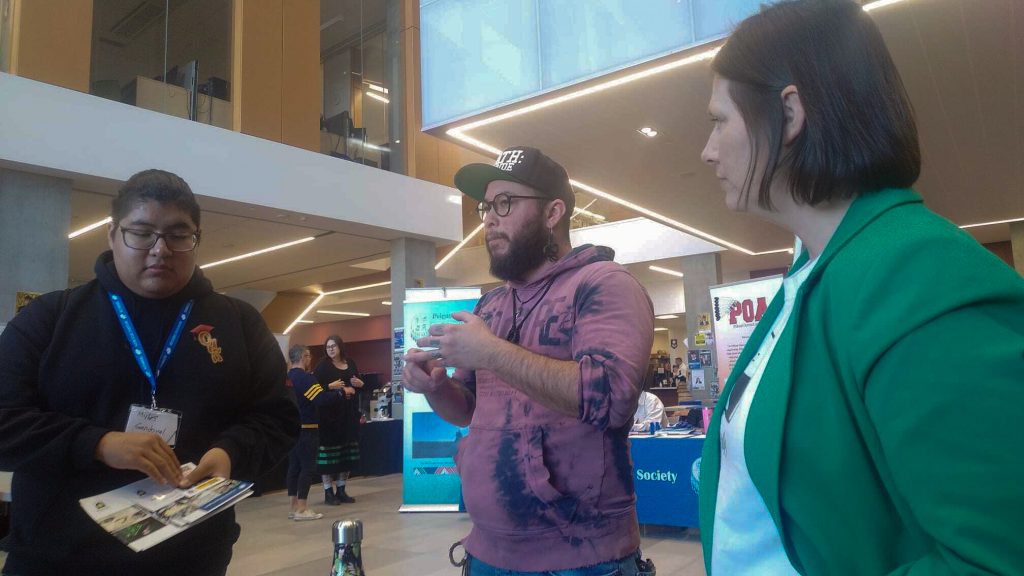
Photo taken of Miguel (middle) at the Iniskim Future Students Day, a recruitment event hosted by the University of Lethbridge where Indigenous students from regional high schools are invited to attend a day of tabling, talks and programming. The Niitistapi Pod presented their works in progress at their table and spoke to students about the Pod’s computer science scholarship.
| 1. Can you tell us what your involvement with AbInt (Abundant Intelligences) has been?
Currently, I’m a mentor for students involved with the Pod, particularly students in Fine Arts. I help students shape their projects and figure out what they need in order to see them through. I’ve also helped with connecting the Pod to communities beyond the University of Lethbridge through public engagement events and publication opportunities. 2. How did your involvement start and what has inspired it? Supporting students in ambitious interdisciplinary projects that incorporate visual art and novel technology is critical work. It’s the work I like best. There’s something really great about having a conversation with a student, encouraging them to think big. You get to see them light up with new ideas, with their own ideas, and then see them run with those ideas. 3. What approaches have you used in working with students? When working with students, I prioritize relationship based, or relation based approaches. Tarot, drawing and writing activities, sometimes we do visualizations of their projects. I did a visualization with a student so she could visualize herself in the scene of the game that she is making. These strategies deepen my relationship with students, students’ relationships with each other, with Pod folks, and with the land around them. When I think about the field trips we’ve had, the group activities, the collective effort for putting together our elder round tables, there is a sense of a big family. This has been a really important model and because we are an Indigenous-majority Pod, it’s not an experimental model. It’s known and familiar to everyone involved. It makes sense. It comes as a big relief because so many students are dealing with code switching and balancing University culture with home cultures. It’s a relief to be within the container of an academic environment using these models for relating that they know. Because we have that family container, it’s less pass or fail like some course environments, and more about how we support each other. I think it’s not without its difficulties; we’ve had a discussion-based decision making model, and that’s never fast or without conflicts. I think it can be surprising and confusing to people who are more used to top-down academic relationship models when undergraduates are being included in discussion on how to move forward on research projects. 4. What keeps you going? Who keeps you going? Many of the students we’ve worked with don’t realize that there’s this massive network of Indigenous scholars and professionals. When they realize the possibilities that are there, it opens up incredible imaginaries for them. When people are actually in it – in the Epistemological Foundations conversations, when they go to the AGM – and they say, “oh my god there is a whole world out there of Indigenous professionals!”. That’s when they actually get to experience it firsthand. It’s so important for students, especially Indigenous students, coming from rural communities, reservations, small towns, to have the experience of meeting all these interdisciplinary Indigenous professionals and see a broad range of career paths actualized. If you’ve been told your options are doctor, lawyer, or teacher, I can’t overstate how impactful it is to see all the directions interdisciplinary research can take you. I think if Indigenous youth knew what options they had in terms of career paths earlier on, we’d see much better numbers in recruitment of Indigenous students for post-secondary education. Over the years, I’ve learned so much from Jackson 2bears, who first got me involved with AbInt. Amethyst First Rider has been a huge inspiration and influence too. I’ve felt very privileged to work alongside her. I really take my cues from her in how to work with students. 5. What’s making a difference for the students you’re working with? Having people from different backgrounds in the same room talking about their work and for the programming and discussion in the Pod to be encouraging the drawing of parallels, connections. One student, Blair Many Fingers, has been doing research around cultural resource management and policy, and now he is making connections to data governance and museum studies, and has been using digital visualizations and poetry to express his research. This unsettling of research tropes opens up possibilities for not only interdisciplinarity, but also cross-cultural knowledge sharing. Some of our Blackfoot students have presented their work both in academic environments and in their home communities. That’s next level code switching. It’s one thing to defend and present your work to an academic community, but then to bring it home where everyone is an expert in the lived experience of what you are talking about – that’s a whole another thing. And so pliability, fluidity, flexibility is what our students are having to develop. Which opens up the possibilities for format and approach to knowledge mobilization. Thinking of art as research, framing art as research, getting creative about how you write, speak, document, and share the work perforates the inaccessible conventions. These alternatives to sharing knowledge better position students at the end of the day to learn at the speed at which culture and technology are developing. By being able to adapt, translate, and codeswitch, our students are uniquely positioned to learn, assimilate, and integrate knowledge and research, and then pass it on to newer students, younger students. Students have a mind for imagining, discussing, collaborating, and making connections that you wouldn’t really have if our Pod was dominated by profs. You wouldn’t have the same intergenerational spitballing – making jokes, teasing each other and teaching each other – that we have in Niitsitapi Pod. You just wouldn’t have that without the students in it. It’s what has made me want to work with this project in the first place. I hope that the researchers and the students just really see the opportunities that exist because of the way we work. I hope that they get really creative with where to take their projects, and see them for all the ways it could benefit their community. |
By:
Sabrina Smith
Date:
December 2, 2025
Location:
Lethbridge, Alberta
Five Minutes With Arts, Community, and Research Consultant, Miguel
By:
Sabrina Smith
Date:
December 2, 2025
Location:
Lethbridge, Alberta
This past week, we caught up with Migueltzinta Solís (Miguel), who is an Arts, Community, and Research Consultant for the Niitsitapi Pod at Abundant Intelligences
Photo taken of Miguel (middle) at the Iniskim Future Students Day, a recruitment event hosted by the University of Lethbridge where Indigenous students from regional high schools are invited to attend a day of tabling, talks and programming. The Niitistapi Pod presented their works in progress at their table and spoke to students about the Pod’s computer science scholarship.
| 1. Can you tell us what your involvement with AbInt (Abundant Intelligences) has been?
Currently, I’m a mentor for students involved with the Pod, particularly students in Fine Arts. I help students shape their projects and figure out what they need in order to see them through. I’ve also helped with connecting the Pod to communities beyond the University of Lethbridge through public engagement events and publication opportunities. 2. How did your involvement start and what has inspired it? Supporting students in ambitious interdisciplinary projects that incorporate visual art and novel technology is critical work. It’s the work I like best. There’s something really great about having a conversation with a student, encouraging them to think big. You get to see them light up with new ideas, with their own ideas, and then see them run with those ideas. 3. What approaches have you used in working with students? When working with students, I prioritize relationship based, or relation based approaches. Tarot, drawing and writing activities, sometimes we do visualizations of their projects. I did a visualization with a student so she could visualize herself in the scene of the game that she is making. These strategies deepen my relationship with students, students’ relationships with each other, with Pod folks, and with the land around them. When I think about the field trips we’ve had, the group activities, the collective effort for putting together our elder round tables, there is a sense of a big family. This has been a really important model and because we are an Indigenous-majority Pod, it’s not an experimental model. It’s known and familiar to everyone involved. It makes sense. It comes as a big relief because so many students are dealing with code switching and balancing University culture with home cultures. It’s a relief to be within the container of an academic environment using these models for relating that they know. Because we have that family container, it’s less pass or fail like some course environments, and more about how we support each other. I think it’s not without its difficulties; we’ve had a discussion-based decision making model, and that’s never fast or without conflicts. I think it can be surprising and confusing to people who are more used to top-down academic relationship models when undergraduates are being included in discussion on how to move forward on research projects. 4. What keeps you going? Who keeps you going? Many of the students we’ve worked with don’t realize that there’s this massive network of Indigenous scholars and professionals. When they realize the possibilities that are there, it opens up incredible imaginaries for them. When people are actually in it – in the Epistemological Foundations conversations, when they go to the AGM – and they say, “oh my god there is a whole world out there of Indigenous professionals!”. That’s when they actually get to experience it firsthand. It’s so important for students, especially Indigenous students, coming from rural communities, reservations, small towns, to have the experience of meeting all these interdisciplinary Indigenous professionals and see a broad range of career paths actualized. If you’ve been told your options are doctor, lawyer, or teacher, I can’t overstate how impactful it is to see all the directions interdisciplinary research can take you. I think if Indigenous youth knew what options they had in terms of career paths earlier on, we’d see much better numbers in recruitment of Indigenous students for post-secondary education. Over the years, I’ve learned so much from Jackson 2bears, who first got me involved with AbInt. Amethyst First Rider has been a huge inspiration and influence too. I’ve felt very privileged to work alongside her. I really take my cues from her in how to work with students. 5. What’s making a difference for the students you’re working with? Having people from different backgrounds in the same room talking about their work and for the programming and discussion in the Pod to be encouraging the drawing of parallels, connections. One student, Blair Many Fingers, has been doing research around cultural resource management and policy, and now he is making connections to data governance and museum studies, and has been using digital visualizations and poetry to express his research. This unsettling of research tropes opens up possibilities for not only interdisciplinarity, but also cross-cultural knowledge sharing. Some of our Blackfoot students have presented their work both in academic environments and in their home communities. That’s next level code switching. It’s one thing to defend and present your work to an academic community, but then to bring it home where everyone is an expert in the lived experience of what you are talking about – that’s a whole another thing. And so pliability, fluidity, flexibility is what our students are having to develop. Which opens up the possibilities for format and approach to knowledge mobilization. Thinking of art as research, framing art as research, getting creative about how you write, speak, document, and share the work perforates the inaccessible conventions. These alternatives to sharing knowledge better position students at the end of the day to learn at the speed at which culture and technology are developing. By being able to adapt, translate, and codeswitch, our students are uniquely positioned to learn, assimilate, and integrate knowledge and research, and then pass it on to newer students, younger students. Students have a mind for imagining, discussing, collaborating, and making connections that you wouldn’t really have if our Pod was dominated by profs. You wouldn’t have the same intergenerational spitballing – making jokes, teasing each other and teaching each other – that we have in Niitsitapi Pod. You just wouldn’t have that without the students in it. It’s what has made me want to work with this project in the first place. I hope that the researchers and the students just really see the opportunities that exist because of the way we work. I hope that they get really creative with where to take their projects, and see them for all the ways it could benefit their community. |