

Five Minutes With Abundant Intelligences’ Tech Pod Member, Hamza Abdelhedi
This past week, we caught up with Tech Pod Member and Biomedical Engineering PhD Student, Hamza Abdelhedi
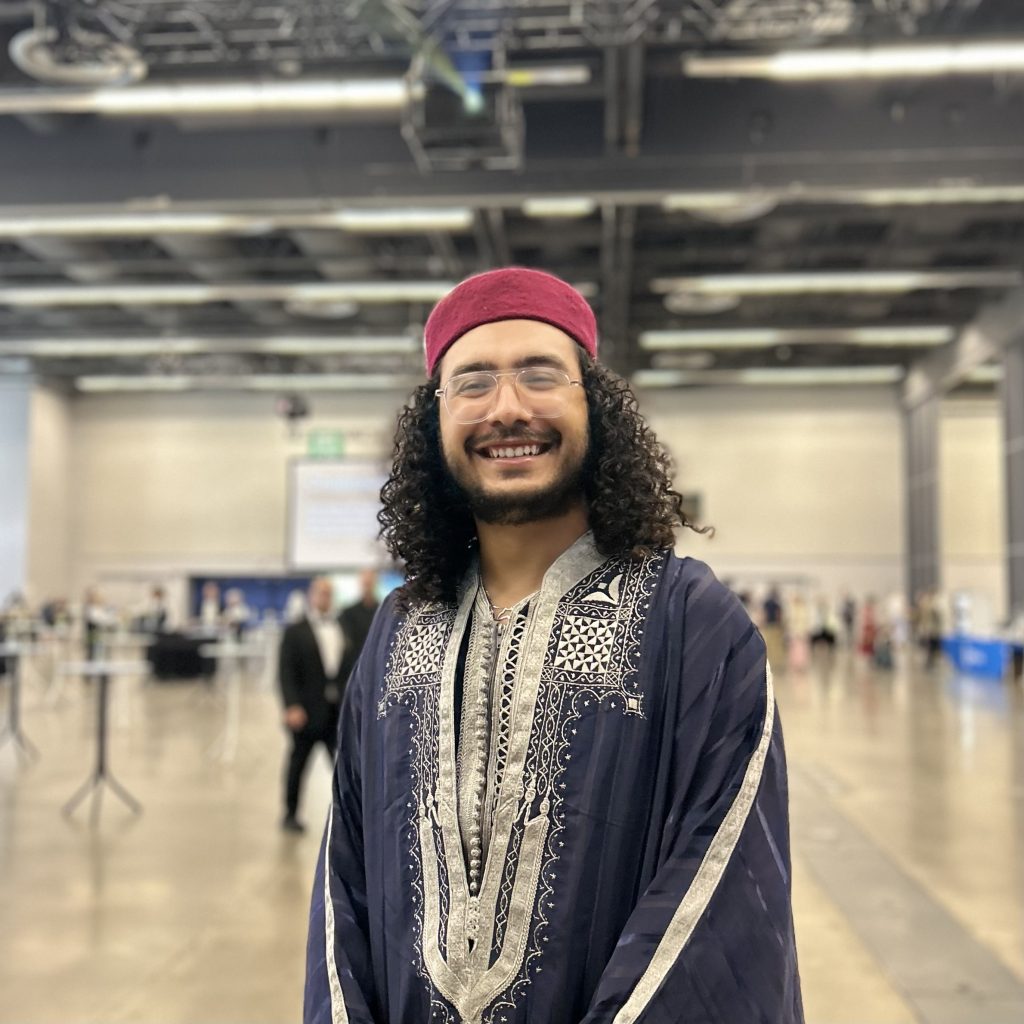
Hamza Abdelhedi is a second-year biomedical engineering PhD student at the University of Montreal and new member of the Abundant Intelligences Tech Pod alongside Dr. Karim Jerbi and Yourguin José Mantilla Ramos. Originally from Sfax, Tunisia, he relocated to Montreal in 2022 and has since continued his multidisciplinary research with Dr. Jerbi at UdeM’s Cognitive and Computational Neuroscience Lab. We sat down with him to explore his current work, new Tech Pod role, and hopes for the future of biomedical AI.
To start out, do you want to talk a bit about your current research?
So I’m still at the beginning of my PhD, just started my 2nd year, so I’m not that advanced in my research career. However, I already completed two years of Masters. For the PhD, I’m still exploring different directions to focus on. I think it will take me 5 years to finish it, or even more. So now I’m currently reading a lot of literature and thinking about what I want to do and how to frame my project, because I need to prepare a project proposal. For context, I work with Dr. Karim Jerbi, who’s the director of the Cognitive and Computational Neuroscience Lab at Psychology Department of UDEM, and who’s also a Co-Investigator at Abundant Intelligences, and currently the co-lead of the Tech Pod. At CoCoLab, we have a diverse set of projects. Some work with behavioral data, others on neuroimaging projects about ADHD, epilepsy, or Alzheimer’s. Some study consciousness, and most of us use AI/ML. It’s very diverse, and that helped me, a bit, shape my interest. What we mainly do is, we use neuroimaging methods and electrophysiology tools like EEG and MEG, combined with advanced analysis methods like signal processing, machine learning, complexity and entropy measures, and deep learning. And we try to understand intelligent systems, both biological, like the brain, and artificial systems.
So… I have been here for like 3 years, I think, now, and with the exposure I got, I figured out what I want to do. Currently, I’m working on epilepsy and ADHD EEG data. Using these recorded brain signals, we are trying to find biomarkers of these neurodevelopmental or neurological conditions. In this project, we are comparing two sets of methods. The old school method: we extract features, we know what type of features we want to extract from those EEG signals. Those could be frequency bands or entropy or complexity measures of the brain. And then we apply relatively “simple” machine learning models, like logistic regression. The second method is where we throw those EEG signals onto very large deep learning models that have been already trained, and we ask them to extract features for us, and then we use these features for classification. And we want to know whether a targeted way of extracting features and applying analysis or a general deep learning way to do it would lead to better results. And inside this project, there are some sub-analysis where we study the effect of psychostimulants and anti-seizure medications. So it’s a large data set with a lot of information in it, a lot of recordings, and we have different paths that we are currently testing.
This is the general idea of this project. And while doing this, I’m also developing my own tools that I want to release for other people at the lab to use, and eventually as open source tools for the community to benefit from in the future. Another topic that interests me is decision-making and how humans make decisions on a day-to-day basis. How this links to my current projects is, for example, studying how medications like methylphenidate for ADHD or other psychostimulants, like caffeine, would modulate brain dynamics within healthy populations and patients. I have several other side projects, but I would frame my research around using AI, machine learning, and signal processing tools to study brain dynamics… the effect of psychostimulants on patients or health populations, and also addressing the question of decision-making and its link to these topics.
That’s great to hear about the open source part!
Yeah, most of my side projects are open source related. I contribute a bit to the community with existing packages, and I recently released a package that I developed.
I’m sure they appreciate it a lot.
Hopefully!
I was going to ask you about the approaches that you use to carry out research, but you went into a little bit of that – and also your open source work kind of ties into that as well. Is there anything else you would want to add about your methodology?
Yeah… Professor Karim’s lab is a methods lab – most of our work is grounded in methods. When I was recruited, I had no background in brain imaging; my background was in signal processing and a bit of AI. Most of our work and research is using these methods with brain data and trying to answer some questions. And like I said, these questions differ from one project to another, but the methods are almost the same. Signal processing, feature extraction, machine learning, deep learning, brain modeling.
It’s cool to get a peek into what goes on in that lab. Is there anything in particular that inspired you to get into these fields?
There were different events. I remember since I was a kid, there were cartoons with scientists – a very stereotypical image of scientists, and I enjoyed watching them a lot. I used to go to the book fair a lot with my mother, and we used to buy a lot of books about science, or scientists, like Einstein, Newton or Pasteur. That helped motivate me to pursue a career in science. I also liked math. After high school, I did 2 years of studying mathematics and physics. Following that, I went into engineering school, where I did 3 years of telecommunication engineering. Here I got most of my foundation in working on signal processing – not on brain data specifically, but other types of time series data. Here, I was also exposed to AI, and how we can use AI for the medical field. So my interest started shaping here.
I remember a class where we used some basic machine learning models to predict tumors in the brain, and I said, this is what I want to do in the future. Back then, at the time, I didn’t know that this whole field of neuroAI existed, or what we could do, or the extent of what was being done. I was just exposed to basic applications. So I started looking into opportunities. I got in touch with Professor Karim, I did an internship with him, and later I joined his lab for a master’s thesis. There, I worked on another neuroAI project. It was different from my current line of research, but still in a close direction. And with exposure I had in the lab, reading articles, attending conferences… that shaped my interest in studying, decision making, and brain disorders. I didn’t have an interest in epilepsy and ADHD per se – but that was the data I got my hands on. So it worked perfectly as I could link it back to decision making, and now I’m still exploring brain dynamics and trying to understand them.
Back to my master’s, it was in AI at Mila, and it was really interesting. However I wanted to do more, address the neuroscience side of the story, so I decided to pursue a PhD in biomedical engineering. And, we know that AI is booming, everyone is using AI, so why not neuroscientists too? So I try to bring domain knowledge and tools from AI/signal processing to the neuroscience field.
Could you talk about how that intersectional work relates to your new role as a member of the Abundant Intelligences Tech Pod?
I come from different backgrounds, so I have talked to experts from multiple domains. And I learned how to find a common ground to help experts from two different fields talk to each other. In other words you can say that I learned how to understand the language of different domains. I think this is what we have and need more of at AbInt… during the AGMs, or, the reading groups or Future Imaginaries workshops, there was this recurrent component. You find a very diverse set of people, like lawyers, artists, scientists, linguists, computer scientists, neuroscientists. And I think my background fits perfectly into that. I have done maths, physics, engineering, AI, and a bit of neuroscience. This will hopefully help bridge the gaps and facilitate discussions between people from different backgrounds.
I have also been teaching in different summer schools. Mainly teaching AI, both to students with an AI background and with no AI background. Which is a very difficult task to do, starting from nothing and finding a common ground to teach people – experts from different fields – complex mechanisms and frameworks with a pace that satisfies everyone’s needs. It was challenging, but I enjoyed doing it. I am also a teaching assistant for some psychology classes. Hopefully I can leverage what I learned in my role as part of AbInt. And if we want to link the previous two points to the goal of the Tech Pod, which is supporting indigenous-led innovation in AI, building technical capacities, creating a collaborative environment, and supporting community-driven projects… I think as part of the student tech team, I would be contributing by doing hands-on AI prototyping, organizing technical workshops to CS and non-CS people, probably creating learning resources, designing curriculums for learners from different backgrounds, and helping with hackathons, seminars, and internships.
Another link I could see with the research I’m doing to AbInt mission in general is – in my research, I’m working on testing deeper and larger models and applying them to brain data, which is similar to what we do in text with ChatGPT. However, there’s an issue with brain data that’s similar to a common issue with language data… For example, with text models, most of the content and data is in English, so all the models are focused and better in English. We have less focus on other languages. For brain data, most of the data comes from one group of people and other groups are not well represented, which makes the model also biased. So while building better models and larger models, I also aim to have better representation for different groups from different backgrounds. I think that could speak to the AbInt mission. And probably also expand the concept of intelligence. Usually when people talk about AI, they mean artificial intelligence as only one type of intelligence. But, through my work on foundation models, brain modeling, and decision making, I hope to expand the definition of AI. As humans we have different aspects of intelligence, and it’s not just about humans. Intelligence can be found in different aspects of nature as well.
I remember that we had a panel with Karim Jerbi a while ago, Epistemological Foundations on AI, and the definition of intelligence came up – he had some really interesting ideas. I’m always curious to hear what you guys are cooking up with expanding the definition of intelligence. Obviously you’re going to be a great addition to the tech pod with that impressive resume! We’re happy to have you. One last question – How do you hope your research will make a difference in your field, community, and or in the wider world?
This is honestly a tough question. I get it a lot when applying for scholarships, and I don’t know what to say, because sometimes I feel that I’m overselling stuff, that I don’t know that it will be achievable or not, but I think that’s part of science. But if I had to answer, I would say that for the current project I’m working on, with ADHD and epilepsy, I think the main goal is to find improved diagnosis and find better biomarkers for these two conditions. If we have more reliable EEG biomarkers, it will help the diagnosis and the doctors’ work. Currently, most of the diagnosis tools are behavioral, for ADHD. For epilepsy, it’s different, but I think the final aim is to make this more automatic, and have a tool that would help doctors eventually add more representation to the data, because now the tools or tests are developed based on research done on specific groups. For example, there is an underrepresentation of women in this type of research. EEG biomarkers research is done mainly on males and it was found out that these biomarkers don’t work for females. This is the line of research I’m interested in.
By comparing old methods and new methods, we could, in ADHD and epilepsy, come up with a framework and directions for how and where to use these models in the clinical field. It is known that these models are considered sometimes as a black box, and we want to have a framework where their use is ethical and does not cause harm. To do this, we need concrete examples of their work, and why they work. As for combining machine learning and foundation models with decision-making, I hope to discover the neural correlates of how humans make decisions, for example how we make fast decisions versus how we make decisions that we take time to think and act based on. And especially when we make those decisions, how our brains work, and to extend on that, how caffeine or medication alter the brain dynamics of the brain while we make these decisions. More broadly, I hope that what I do will help the community, whether that’s with the tools I publish or my findings. And I hope to contribute to more human-centered, community-aware uses of AI in health, including with spaces like Abundant Intelligences, to answer Indigenous-led questions. This is a far-fetched aim, but let’s hope for a better future.
By:
Hazel Dreslinski
Date:
January 8, 2026
Location:
Montreal, Canada
Five Minutes With Abundant Intelligences’ Tech Pod Member, Hamza Abdelhedi
By:
Hazel Dreslinski
Date:
January 8, 2026
Location:
Montreal, Canada
This past week, we caught up with Tech Pod Member and Biomedical Engineering PhD Student, Hamza Abdelhedi
Hamza Abdelhedi is a second-year biomedical engineering PhD student at the University of Montreal and new member of the Abundant Intelligences Tech Pod alongside Dr. Karim Jerbi and Yourguin José Mantilla Ramos. Originally from Sfax, Tunisia, he relocated to Montreal in 2022 and has since continued his multidisciplinary research with Dr. Jerbi at UdeM’s Cognitive and Computational Neuroscience Lab. We sat down with him to explore his current work, new Tech Pod role, and hopes for the future of biomedical AI.
To start out, do you want to talk a bit about your current research?
So I’m still at the beginning of my PhD, just started my 2nd year, so I’m not that advanced in my research career. However, I already completed two years of Masters. For the PhD, I’m still exploring different directions to focus on. I think it will take me 5 years to finish it, or even more. So now I’m currently reading a lot of literature and thinking about what I want to do and how to frame my project, because I need to prepare a project proposal. For context, I work with Dr. Karim Jerbi, who’s the director of the Cognitive and Computational Neuroscience Lab at Psychology Department of UDEM, and who’s also a Co-Investigator at Abundant Intelligences, and currently the co-lead of the Tech Pod. At CoCoLab, we have a diverse set of projects. Some work with behavioral data, others on neuroimaging projects about ADHD, epilepsy, or Alzheimer’s. Some study consciousness, and most of us use AI/ML. It’s very diverse, and that helped me, a bit, shape my interest. What we mainly do is, we use neuroimaging methods and electrophysiology tools like EEG and MEG, combined with advanced analysis methods like signal processing, machine learning, complexity and entropy measures, and deep learning. And we try to understand intelligent systems, both biological, like the brain, and artificial systems.
So… I have been here for like 3 years, I think, now, and with the exposure I got, I figured out what I want to do. Currently, I’m working on epilepsy and ADHD EEG data. Using these recorded brain signals, we are trying to find biomarkers of these neurodevelopmental or neurological conditions. In this project, we are comparing two sets of methods. The old school method: we extract features, we know what type of features we want to extract from those EEG signals. Those could be frequency bands or entropy or complexity measures of the brain. And then we apply relatively “simple” machine learning models, like logistic regression. The second method is where we throw those EEG signals onto very large deep learning models that have been already trained, and we ask them to extract features for us, and then we use these features for classification. And we want to know whether a targeted way of extracting features and applying analysis or a general deep learning way to do it would lead to better results. And inside this project, there are some sub-analysis where we study the effect of psychostimulants and anti-seizure medications. So it’s a large data set with a lot of information in it, a lot of recordings, and we have different paths that we are currently testing.
This is the general idea of this project. And while doing this, I’m also developing my own tools that I want to release for other people at the lab to use, and eventually as open source tools for the community to benefit from in the future. Another topic that interests me is decision-making and how humans make decisions on a day-to-day basis. How this links to my current projects is, for example, studying how medications like methylphenidate for ADHD or other psychostimulants, like caffeine, would modulate brain dynamics within healthy populations and patients. I have several other side projects, but I would frame my research around using AI, machine learning, and signal processing tools to study brain dynamics… the effect of psychostimulants on patients or health populations, and also addressing the question of decision-making and its link to these topics.
That’s great to hear about the open source part!
Yeah, most of my side projects are open source related. I contribute a bit to the community with existing packages, and I recently released a package that I developed.
I’m sure they appreciate it a lot.
Hopefully!
I was going to ask you about the approaches that you use to carry out research, but you went into a little bit of that – and also your open source work kind of ties into that as well. Is there anything else you would want to add about your methodology?
Yeah… Professor Karim’s lab is a methods lab – most of our work is grounded in methods. When I was recruited, I had no background in brain imaging; my background was in signal processing and a bit of AI. Most of our work and research is using these methods with brain data and trying to answer some questions. And like I said, these questions differ from one project to another, but the methods are almost the same. Signal processing, feature extraction, machine learning, deep learning, brain modeling.
It’s cool to get a peek into what goes on in that lab. Is there anything in particular that inspired you to get into these fields?
There were different events. I remember since I was a kid, there were cartoons with scientists – a very stereotypical image of scientists, and I enjoyed watching them a lot. I used to go to the book fair a lot with my mother, and we used to buy a lot of books about science, or scientists, like Einstein, Newton or Pasteur. That helped motivate me to pursue a career in science. I also liked math. After high school, I did 2 years of studying mathematics and physics. Following that, I went into engineering school, where I did 3 years of telecommunication engineering. Here I got most of my foundation in working on signal processing – not on brain data specifically, but other types of time series data. Here, I was also exposed to AI, and how we can use AI for the medical field. So my interest started shaping here.
I remember a class where we used some basic machine learning models to predict tumors in the brain, and I said, this is what I want to do in the future. Back then, at the time, I didn’t know that this whole field of neuroAI existed, or what we could do, or the extent of what was being done. I was just exposed to basic applications. So I started looking into opportunities. I got in touch with Professor Karim, I did an internship with him, and later I joined his lab for a master’s thesis. There, I worked on another neuroAI project. It was different from my current line of research, but still in a close direction. And with exposure I had in the lab, reading articles, attending conferences… that shaped my interest in studying, decision making, and brain disorders. I didn’t have an interest in epilepsy and ADHD per se – but that was the data I got my hands on. So it worked perfectly as I could link it back to decision making, and now I’m still exploring brain dynamics and trying to understand them.
Back to my master’s, it was in AI at Mila, and it was really interesting. However I wanted to do more, address the neuroscience side of the story, so I decided to pursue a PhD in biomedical engineering. And, we know that AI is booming, everyone is using AI, so why not neuroscientists too? So I try to bring domain knowledge and tools from AI/signal processing to the neuroscience field.
Could you talk about how that intersectional work relates to your new role as a member of the Abundant Intelligences Tech Pod?
I come from different backgrounds, so I have talked to experts from multiple domains. And I learned how to find a common ground to help experts from two different fields talk to each other. In other words you can say that I learned how to understand the language of different domains. I think this is what we have and need more of at AbInt… during the AGMs, or, the reading groups or Future Imaginaries workshops, there was this recurrent component. You find a very diverse set of people, like lawyers, artists, scientists, linguists, computer scientists, neuroscientists. And I think my background fits perfectly into that. I have done maths, physics, engineering, AI, and a bit of neuroscience. This will hopefully help bridge the gaps and facilitate discussions between people from different backgrounds.
I have also been teaching in different summer schools. Mainly teaching AI, both to students with an AI background and with no AI background. Which is a very difficult task to do, starting from nothing and finding a common ground to teach people – experts from different fields – complex mechanisms and frameworks with a pace that satisfies everyone’s needs. It was challenging, but I enjoyed doing it. I am also a teaching assistant for some psychology classes. Hopefully I can leverage what I learned in my role as part of AbInt. And if we want to link the previous two points to the goal of the Tech Pod, which is supporting indigenous-led innovation in AI, building technical capacities, creating a collaborative environment, and supporting community-driven projects… I think as part of the student tech team, I would be contributing by doing hands-on AI prototyping, organizing technical workshops to CS and non-CS people, probably creating learning resources, designing curriculums for learners from different backgrounds, and helping with hackathons, seminars, and internships.
Another link I could see with the research I’m doing to AbInt mission in general is – in my research, I’m working on testing deeper and larger models and applying them to brain data, which is similar to what we do in text with ChatGPT. However, there’s an issue with brain data that’s similar to a common issue with language data… For example, with text models, most of the content and data is in English, so all the models are focused and better in English. We have less focus on other languages. For brain data, most of the data comes from one group of people and other groups are not well represented, which makes the model also biased. So while building better models and larger models, I also aim to have better representation for different groups from different backgrounds. I think that could speak to the AbInt mission. And probably also expand the concept of intelligence. Usually when people talk about AI, they mean artificial intelligence as only one type of intelligence. But, through my work on foundation models, brain modeling, and decision making, I hope to expand the definition of AI. As humans we have different aspects of intelligence, and it’s not just about humans. Intelligence can be found in different aspects of nature as well.
I remember that we had a panel with Karim Jerbi a while ago, Epistemological Foundations on AI, and the definition of intelligence came up – he had some really interesting ideas. I’m always curious to hear what you guys are cooking up with expanding the definition of intelligence. Obviously you’re going to be a great addition to the tech pod with that impressive resume! We’re happy to have you. One last question – How do you hope your research will make a difference in your field, community, and or in the wider world?
This is honestly a tough question. I get it a lot when applying for scholarships, and I don’t know what to say, because sometimes I feel that I’m overselling stuff, that I don’t know that it will be achievable or not, but I think that’s part of science. But if I had to answer, I would say that for the current project I’m working on, with ADHD and epilepsy, I think the main goal is to find improved diagnosis and find better biomarkers for these two conditions. If we have more reliable EEG biomarkers, it will help the diagnosis and the doctors’ work. Currently, most of the diagnosis tools are behavioral, for ADHD. For epilepsy, it’s different, but I think the final aim is to make this more automatic, and have a tool that would help doctors eventually add more representation to the data, because now the tools or tests are developed based on research done on specific groups. For example, there is an underrepresentation of women in this type of research. EEG biomarkers research is done mainly on males and it was found out that these biomarkers don’t work for females. This is the line of research I’m interested in.
By comparing old methods and new methods, we could, in ADHD and epilepsy, come up with a framework and directions for how and where to use these models in the clinical field. It is known that these models are considered sometimes as a black box, and we want to have a framework where their use is ethical and does not cause harm. To do this, we need concrete examples of their work, and why they work. As for combining machine learning and foundation models with decision-making, I hope to discover the neural correlates of how humans make decisions, for example how we make fast decisions versus how we make decisions that we take time to think and act based on. And especially when we make those decisions, how our brains work, and to extend on that, how caffeine or medication alter the brain dynamics of the brain while we make these decisions. More broadly, I hope that what I do will help the community, whether that’s with the tools I publish or my findings. And I hope to contribute to more human-centered, community-aware uses of AI in health, including with spaces like Abundant Intelligences, to answer Indigenous-led questions. This is a far-fetched aim, but let’s hope for a better future.