
Five Minutes With Maurice Jones: Black and Indigenous Approaches to AI
What does it mean to bring AI technologies into places where Indigenous knowledges already exist?
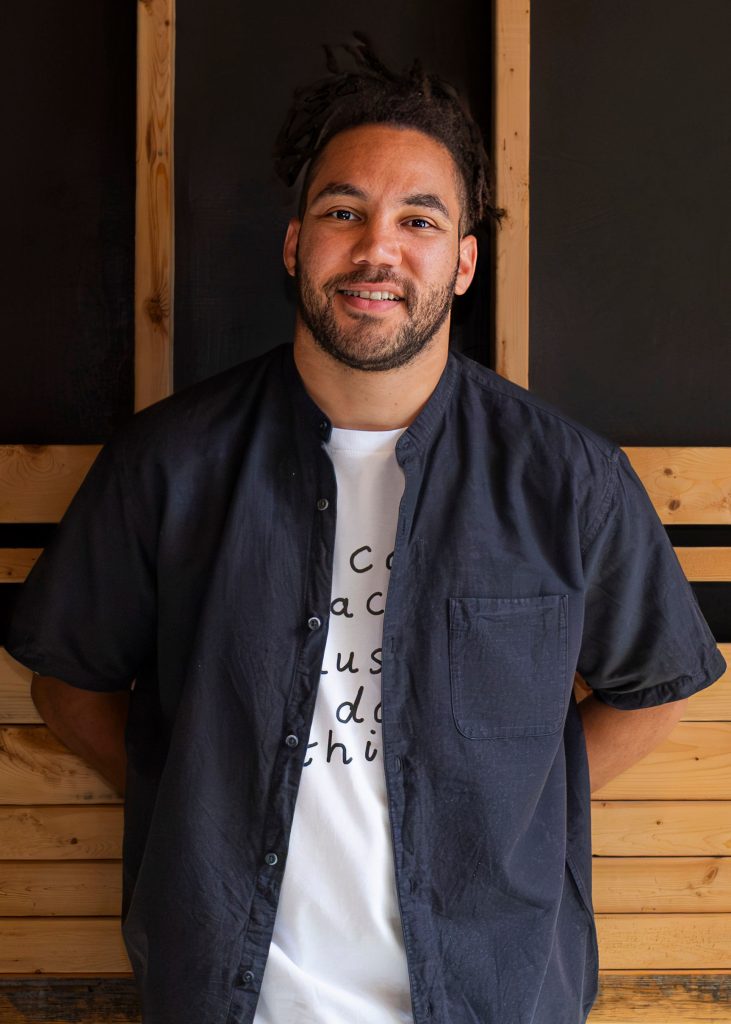
Maurice Jones
Can you tell us in simple terms what your current research or project is about?
Well, there’s several layers to my research. There’s one, the PhD thesis that I’m writing right now, trying to finish, which is broadly on the history of new media arts festivals, such as MUTEK, which is a festival that I’ve been working with for almost a decade. I was one of the initiators behind the Japan edition of MUTEK in 2016, and now I’ve been working with the Montreal edition.
My thesis is mostly about how these festivals can make possible futures experiential. It’s kind of like science fiction in action, through the work of amazing artists that bring these fictional worlds into being. You can go to these festivals and you have a bunch of different artists. It’s like you can try different possible futures out somehow. And not only by yourself, but together with other people that are in the space with you there. Then you see what fits, and maybe you make friends along the way, get inspiration, and carry that forward.
That’s kind of my thesis: how festivals can be these spaces where we can see for a brief moment what possible futures might be like, and they’re actually possible because we’re all there together and experiencing that possible future. That’s the crux that I’m trying to explain in my thesis.
Then the research that I’ve been doing with Abundant Intelligences is a bit more focused on research creation. I’m also an artist and create different performances and installations. For the Call for Proposals (CfP), I’ve been exploring Black approaches and Indigenous approaches to AI, and through creative practice, what kind of intersections could be there. Where might there be potentials for collaboration, trying to resist the oppressive ways that AI is being done right now, and mapping out what kind of potentials for collaboration could be there.
That’s what I’ve been working on as part of Abundant Intelligences, apart from being here, hanging out, and going to Aotearoa two years ago, which was really wonderful, and being part of the learners and participating in the symposia.
Do you want to quickly touch on what Abundant Learners is? Is it a group?
Abundant Intelligences has all these different pods around the world that are under this umbrella. The Abundant Learners was a space that Rob Marinov and Ceyda Yolgörmez orchestrated for masters, PhD students, and postdocs to come together and have a space to exchange, support each other, and learn together. It’s a bit separate from the reading group that we’re also having, which we just started again two weeks ago. We did it last summer and fall. We meet every two weeks and read different Indigenous perspectives on AI.
Next week, I’m hosting one reading group session on Black and Indigenous approaches to AI and what that could look like. It’s been a very generative place to converse.
What inspired you to explore this topic, and why is it important right now?
I started here at Concordia five years ago, and Abundant Intelligences didn’t exist yet, but the Indigenous AI research group and AppTech were at Milieux. I was spending a lot of time in Milieux, but I didn’t really know how to make connections.
When Abundant Intelligences started and Fenwick McKelvey, my supervisor, was part of it, that gave me an inroad to enter that space. I’m originally from Germany and arrived in Canada four and a half years ago. The histories of Indigeneity in North America were something I knew a bit about, but not what they’re actually like in practice.
For the first few years, I was observing, experiencing things like white people doing land acknowledgements at universities and wondering what was going on. It felt strange and out of place. Over the years of observing and learning what’s going on, I also collaborated with imagineNATIVE, the Indigenous media arts, film, and media arts festival in Toronto, in the last two years. That taught me a lot. I’m very close with Naomi Johnson, the executive director there, and she taught me how to approach things.
When Abundant Intelligences came around and I had this connection through Fenwick, it felt like a good moment to make more effort in getting in touch. I’m Afro-German—my father is African American and my mother is German—so Black approaches are also something I’ve been thinking about a lot. Bringing those two into conversation felt like a good starting point, starting from my own positionality and standpoints and entering that space with that background to see what the connections could be.
How has it evolved?
My challenge right now is that I’m connected to this great research group of very diverse Indigenous scholars and communities, but every time I talk about the project, people ask which Indigenous communities I’m working with on the ground. That’s the biggest challenge because I’m not sure how to approach that.
Sometimes it sounds like a demand that I have to work with people who live here in Tiohtià:ke, Montreal. That feels like it would be a performative move, because that’s not really the connection I have. My connection is around the topic of AI, Black approaches, and diverse Indigenous approaches, rather than being on a specific land and needing to engage with specific people.
Looking at my past experience, I lived in Japan for almost ten years. As a half-Black, half-German person, I’ve often been in a mediating space, navigating borderlands between different ways of seeing the world. Entering this space feels similar. Before engaging with one specific community, for now I continue in that borderland role of navigating different perspectives and who knows, maybe further down the line this generates a possibility to work with a specific community on the ground.
Abundant Intelligences is a great space for that because we have pods in Aotearoa and all over North America. That’s been very fruitful. It doesn’t mean I don’t want to engage with local communities, but I don’t feel I have the right context or background yet, and doing it would feel performative, not authentic.
How has Abundant Intelligences helped with this research or project?
It’s not tied directly to my PhD project, even though there’s overlap in research creation. It’s a separate project. It’s given me a community to exchange ideas with. I brought these questions to the Abundant Learners meetings and the reading groups and asked Indigenous scholars and artists what they felt, not expecting answers, but valuing the exchange.
With the CFP, we got some funding to explore ideas. I’ve been working with Raspberry Pi’s, putting language models on them and having them exist as individual entities not connected to the internet.
I got a lot of inspiration from marooning, the history of runaway slaves in North America, who escaped into swamps and built autonomous communities, but those lands were already traversed by Indigenous communities. Conceptually, that meeting ground became very interesting: people taken from their homeland, brought to another people’s homeland, building new relationships.
I took that inspiration and built technologies representing it, imagining the Raspberry Pi’s as maroon technologies, fugitive AIs that ran away into the wilderness. I actually took them into swamps in southern Quebec during a residency on a farm. I built them, took them to the swamps, and then brought them back.
For the CFP, the next step was thinking about what it means to bring these technologies into places where Indigenous knowledge already exists, and how these sound robots might encounter those knowledges.
What methods and approaches are you using?
The main method is research creation, building technologies and artistic works to explore these questions. There’s also a lot of reading, especially the work of Suzanne Kite with Alisha B. Wormsley. Together they did a workshop for Black and Indigenous artists on dreaming.
Conceptually, I’ve been thinking about haunting and dreaming. Haunting considers how technologies are shaped by the past, through data, extraction of resources, and labour. It’s material and immaterial, tangible and intangible, and can mean different things to different communities. Technologies are haunted differently for Black communities than for Indigenous communities.
Dreaming also felt generative. It’s easier to decolonize an intangible space. In dreams, no one can say it’s scientifically wrong, it’s a dream. Those are the two sides I’ve been working with so far.
Last question: how do you hope your research will make a difference?
I hope to challenge how AI is being propagated through hype and controlled by very few people. I want to inspire the idea that there are multiple ways of doing AI—Black, Indigenous, queer, Latinx, and other critical and cultural approaches that many people don’t know about.
Dreaming is the first step toward making change. We don’t have to accept how things are done. There are people actually doing it. Aotearoa was inspirational, meeting people from Te Hiku Media showed that building your own data centers and language models isn’t easy, but it’s possible. Those are the role models we need.
By:
Jill Kinsaschuk
Date:
April 27, 2026
Location:
Tiohtià:ke/Montréal, Canada
Five Minutes With Maurice Jones: Black and Indigenous Approaches to AI
By:
Jill Kinsaschuk
Date:
April 27, 2026
Location:
Tiohtià:ke/Montréal, Canada
What does it mean to bring AI technologies into places where Indigenous knowledges already exist?
Maurice Jones
Can you tell us in simple terms what your current research or project is about?
Well, there’s several layers to my research. There’s one, the PhD thesis that I’m writing right now, trying to finish, which is broadly on the history of new media arts festivals, such as MUTEK, which is a festival that I’ve been working with for almost a decade. I was one of the initiators behind the Japan edition of MUTEK in 2016, and now I’ve been working with the Montreal edition.
My thesis is mostly about how these festivals can make possible futures experiential. It’s kind of like science fiction in action, through the work of amazing artists that bring these fictional worlds into being. You can go to these festivals and you have a bunch of different artists. It’s like you can try different possible futures out somehow. And not only by yourself, but together with other people that are in the space with you there. Then you see what fits, and maybe you make friends along the way, get inspiration, and carry that forward.
That’s kind of my thesis: how festivals can be these spaces where we can see for a brief moment what possible futures might be like, and they’re actually possible because we’re all there together and experiencing that possible future. That’s the crux that I’m trying to explain in my thesis.
Then the research that I’ve been doing with Abundant Intelligences is a bit more focused on research creation. I’m also an artist and create different performances and installations. For the Call for Proposals (CfP), I’ve been exploring Black approaches and Indigenous approaches to AI, and through creative practice, what kind of intersections could be there. Where might there be potentials for collaboration, trying to resist the oppressive ways that AI is being done right now, and mapping out what kind of potentials for collaboration could be there.
That’s what I’ve been working on as part of Abundant Intelligences, apart from being here, hanging out, and going to Aotearoa two years ago, which was really wonderful, and being part of the learners and participating in the symposia.
Do you want to quickly touch on what Abundant Learners is? Is it a group?
Abundant Intelligences has all these different pods around the world that are under this umbrella. The Abundant Learners was a space that Rob Marinov and Ceyda Yolgörmez orchestrated for masters, PhD students, and postdocs to come together and have a space to exchange, support each other, and learn together. It’s a bit separate from the reading group that we’re also having, which we just started again two weeks ago. We did it last summer and fall. We meet every two weeks and read different Indigenous perspectives on AI.
Next week, I’m hosting one reading group session on Black and Indigenous approaches to AI and what that could look like. It’s been a very generative place to converse.
What inspired you to explore this topic, and why is it important right now?
I started here at Concordia five years ago, and Abundant Intelligences didn’t exist yet, but the Indigenous AI research group and AppTech were at Milieux. I was spending a lot of time in Milieux, but I didn’t really know how to make connections.
When Abundant Intelligences started and Fenwick McKelvey, my supervisor, was part of it, that gave me an inroad to enter that space. I’m originally from Germany and arrived in Canada four and a half years ago. The histories of Indigeneity in North America were something I knew a bit about, but not what they’re actually like in practice.
For the first few years, I was observing, experiencing things like white people doing land acknowledgements at universities and wondering what was going on. It felt strange and out of place. Over the years of observing and learning what’s going on, I also collaborated with imagineNATIVE, the Indigenous media arts, film, and media arts festival in Toronto, in the last two years. That taught me a lot. I’m very close with Naomi Johnson, the executive director there, and she taught me how to approach things.
When Abundant Intelligences came around and I had this connection through Fenwick, it felt like a good moment to make more effort in getting in touch. I’m Afro-German—my father is African American and my mother is German—so Black approaches are also something I’ve been thinking about a lot. Bringing those two into conversation felt like a good starting point, starting from my own positionality and standpoints and entering that space with that background to see what the connections could be.
How has it evolved?
My challenge right now is that I’m connected to this great research group of very diverse Indigenous scholars and communities, but every time I talk about the project, people ask which Indigenous communities I’m working with on the ground. That’s the biggest challenge because I’m not sure how to approach that.
Sometimes it sounds like a demand that I have to work with people who live here in Tiohtià:ke, Montreal. That feels like it would be a performative move, because that’s not really the connection I have. My connection is around the topic of AI, Black approaches, and diverse Indigenous approaches, rather than being on a specific land and needing to engage with specific people.
Looking at my past experience, I lived in Japan for almost ten years. As a half-Black, half-German person, I’ve often been in a mediating space, navigating borderlands between different ways of seeing the world. Entering this space feels similar. Before engaging with one specific community, for now I continue in that borderland role of navigating different perspectives and who knows, maybe further down the line this generates a possibility to work with a specific community on the ground.
Abundant Intelligences is a great space for that because we have pods in Aotearoa and all over North America. That’s been very fruitful. It doesn’t mean I don’t want to engage with local communities, but I don’t feel I have the right context or background yet, and doing it would feel performative, not authentic.
How has Abundant Intelligences helped with this research or project?
It’s not tied directly to my PhD project, even though there’s overlap in research creation. It’s a separate project. It’s given me a community to exchange ideas with. I brought these questions to the Abundant Learners meetings and the reading groups and asked Indigenous scholars and artists what they felt, not expecting answers, but valuing the exchange.
With the CFP, we got some funding to explore ideas. I’ve been working with Raspberry Pi’s, putting language models on them and having them exist as individual entities not connected to the internet.
I got a lot of inspiration from marooning, the history of runaway slaves in North America, who escaped into swamps and built autonomous communities, but those lands were already traversed by Indigenous communities. Conceptually, that meeting ground became very interesting: people taken from their homeland, brought to another people’s homeland, building new relationships.
I took that inspiration and built technologies representing it, imagining the Raspberry Pi’s as maroon technologies, fugitive AIs that ran away into the wilderness. I actually took them into swamps in southern Quebec during a residency on a farm. I built them, took them to the swamps, and then brought them back.
For the CFP, the next step was thinking about what it means to bring these technologies into places where Indigenous knowledge already exists, and how these sound robots might encounter those knowledges.
What methods and approaches are you using?
The main method is research creation, building technologies and artistic works to explore these questions. There’s also a lot of reading, especially the work of Suzanne Kite with Alisha B. Wormsley. Together they did a workshop for Black and Indigenous artists on dreaming.
Conceptually, I’ve been thinking about haunting and dreaming. Haunting considers how technologies are shaped by the past, through data, extraction of resources, and labour. It’s material and immaterial, tangible and intangible, and can mean different things to different communities. Technologies are haunted differently for Black communities than for Indigenous communities.
Dreaming also felt generative. It’s easier to decolonize an intangible space. In dreams, no one can say it’s scientifically wrong, it’s a dream. Those are the two sides I’ve been working with so far.
Last question: how do you hope your research will make a difference?
I hope to challenge how AI is being propagated through hype and controlled by very few people. I want to inspire the idea that there are multiple ways of doing AI—Black, Indigenous, queer, Latinx, and other critical and cultural approaches that many people don’t know about.
Dreaming is the first step toward making change. We don’t have to accept how things are done. There are people actually doing it. Aotearoa was inspirational, meeting people from Te Hiku Media showed that building your own data centers and language models isn’t easy, but it’s possible. Those are the role models we need.