Five Minutes With Hēmi Whaanga: Staying Grounded in Community
How does AI and other technologies connect into Indigenous knowledge bases, and to the principles, protocols, and values that are embedded within those?
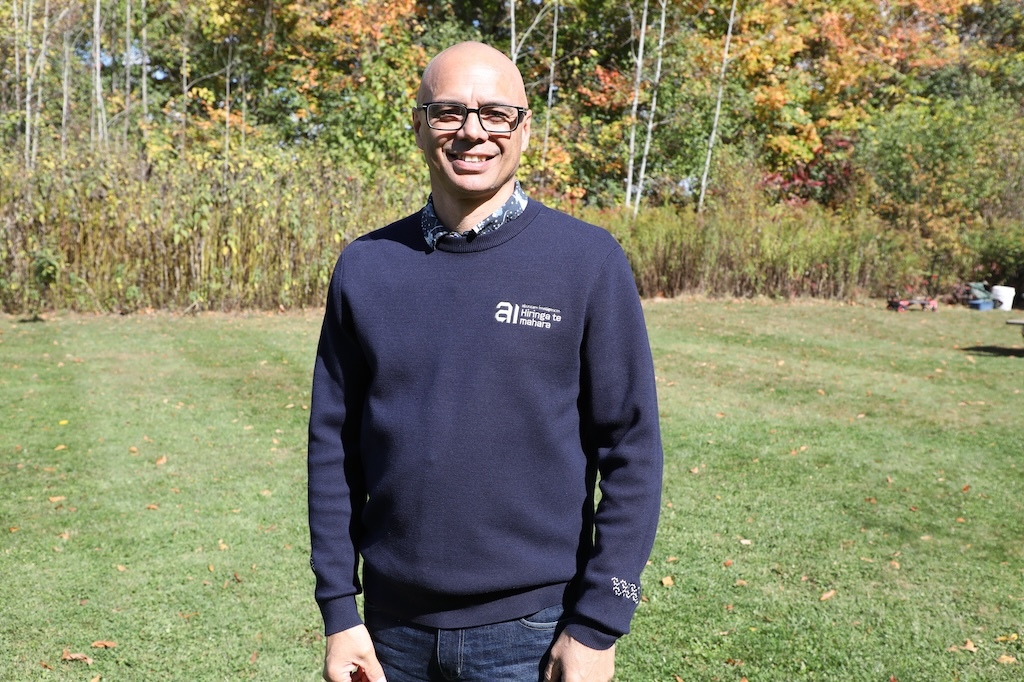
Hēmi Whaanga at Abundant Intelligences’ Third AGM
1. Can you tell us, in simple terms, what your current research or project is about?
One of the things that I’ve personally been thinking about for a long time is creating systems and methods around how we use technologies. AI is one of these, and virtual reality is another. How do these technologies connect into our knowledge bases, and to the principles, protocols, and values that are embedded within those? As tools, these technologies act as mechanisms or means to connect people back to place and space. So a lot of my research is around that. I have multiple projects at the moment and I supervise a lot of projects in this space.
For example, in some projects we are looking at the use of transitions in VR that relate to place, the knowledge associated with place, and the protocols around that knowledge. Another area of work focuses on using technology around virtual tourism. How do AI and other technologies connect people to those places and spaces they visit? And welcoming people in as visitors, we call it Manuhiri, which is a visitor in Māori. How do you welcome Manuhiri into your stories, history, place, and environment? How can you welcome them into that, but also use a range of technologies for people who want to view it in different ways? For example, for those who want to visit, but can’t physically visit anymore. There are many examples of elders who have gotten too old to go back home or to a place. And so how do you create an environment where they can experience home? And people from overseas who want to come to Aotearoa or New Zealand, but can’t physically go there, and others who are planning to visit, or who have already arrived. How do you enhance their experience, and how do you push them to particular infrastructures or places of importance?
This work extends into more recent research, including Abundant Intelligences and other projects that I consider to be interest-driven. In this space, I also sit on advisory work related to Alzheimer’s, which is particularly prevalent among Māori and within my own family.
We’re also looking at the use of Māori language in New Zealand English, and how Māori terms have been used and how people use them as identifiers—that sort of thing. I come from a linguistic background and I’m working with one of my friends at the University of Waikato, Andreea Calude, around doing stuff like that.
2. What inspired you to start exploring these topics, and why is it important right now?
I think a lot of these interests have kind of sprung up from my own journey, from learning a language and culture, and from my thinking about my own communities. My communities of interest include, for example, where I grew up down in the south or the bottom of the South Island.
The experience of growing up in a community that was revitalizing the language and culture has carried through my work with my other communities of interest, which include my colleagues and people working at the University in Indigenous Studies and Māori Studies. In my role as Head of a School that teaches Māori Studies, I get to kind of connect with an array of different people who are doing Indigenous education, Māori education. We have a teacher training cohort that we train into Māori medium schools. I get to engage with them all the time and see what their needs are. For me, an interest in language, learning, and cultural understanding through education is still kind of percolating away.
Another area of interest relates to health or well-being, which connects to what we call Hauora, a philosophy of holistic wellbeing: physical, mental, and spiritual. I’m interested in it because it’s about being well and being grounded, and it also connects to the research around Alzheimer’s.
There is also a strand of work focussed on teaching language, culture, and critical studies. This involves looking at how people engage with political and social constructs, broadly, and being a part of those conversations on a day-to-day basis. This keeps me enthused about what I do, apart from my administrative role. It also raises questions such as: how do you design curriculum to respond to new technologies? We’ve started papers and degree structures around some of the research we’ve been conducting. We’ve also begun to translate this research and earlier research into papers that we teach and share with students. A key question for me is: in collaboration with community, how do you use this to develop actual courses, papers, and programs? A lot of research around the languages, language teaching, and Māori medium teaching was developed with community. How do you actually maintain those relationships from a very independent organization, which is grounded in grassroots, into a Western type of institute structure? You’ve got to maintain all those kinds of connections and relationships. All the stuff I do is related to that, more broadly.
3. What methods or approaches are you using to carry out your research?
There are multiple. I co-teach a Māori methodology course with one of my colleagues and the methodologies we talk about are co-constructing with community and working with community. In Aotearoa or New Zealand, we have a method that was born out of early education responses to establishing our own kind of a Māori medium education. These are from people like Linda Tuhiwai Smith, Graham Hingangaroa Smith, and Leonie Pihama and all the rest of them from their time. We are talking about the 1980s and 1990s, a group of academics in the University of Auckland, all educationalists, completing their PhDs, and noticed that there was a lack of our own methodologies and critical theory. This led to what we use now: Kaupapa Māori research methodology and we teach a bit about that. A lot of it is about being faithful to who you are and your own identity and in applying particular approaches on engaging with our people, ensuring that there is a particular process that you follow embedded in our own processes and understanding of how our cultural protocols work.
Kaupapa Māori is widely used by many Māori researchers now and these ideas underpin its theoretical foundation. Earlier, I used a lot of critical discourse analysis because I come from a linguistic background. I focussed on looking at linguistic theory and embedding it within ways of working with community and for community. I think those kinds of methodologies where you’re listening to them and then responding as a researcher and responding as a research group, are very much embedded in a lot of things that I’ve been doing for quite a while now.
When my uncle says, you need to go and do this and you go, okay, well, how does that work? And then I go and work in particular ways with agencies, funding bodies, and students. The methodologies course we teach is a lot about showing students particular examples and experiences that we’ve had, as…I wouldn’t call myself a senior researcher, but I’m starting to feel it now.
It’s not just on paper, it is your own lived experiences and mistakes that you’ve made and hopefully they haven’t been too damaging to your career and all your people that you work with. All those things are a lot better to share than material just taken directly out of a book. You can reflect on the good pieces and the difficult things and say that I wouldn’t do it that way because this is what I did and it was very difficult to do that. When I think about methodologies and research, I think about how you enhance the well-being or the opportunity for everyone, not only Māori communities, but non-Māori communities as well.
The stuff I have been doing on dementia that I’m an advisor on, there is a large portion of non-Indigenous that are affected by it. And they’re not Indigenous, we do things a particular way because of our cultural, social and familial structure, and potentially the networks of care can be very different if you come from a different cultural and social structure. Then sharing that opportunity to actually say, well, can we take a combination and take the great things that you’re doing and share that.
Because at the end of the day, it’s for our people. And I think we are all engaging in all these things around research and what research is really for and if it doesn’t have a good outcome that benefits people, then why do it? The days where you do research, just for yourself, I think those days are changing and they have changed.
A lot of funds talk about transforming. What does “x” mean to transform through doing research for, by and with communities? I think that’s what the exciting part is. That’s what keeps me up in the morning, I suppose. And my kids would go, what are you doing today, Dad? I’m working with this person and I’m engaging with this group and then we’re constructing this. I left school, trained as a plumber, and worked in trades. Thirty or forty years later, I’m doing something very, very different that has a different focus and different opportunities. I am used to dealing with people’s crap. I can apply those sorts of learnings to having to deal with all the crap I deal with on a day-to-day basis. Coming from a trade, you learn a different skill set and different problem solving. It’s very easy to transfer that to working with and in communities.
I have worked with people that have gone from high school, into tertiary (higher ed) and have stayed there their whole life. There is a particular way that they behave and act, and a lot of those values are engrained in the high level thinking that they’ve been doing. We used to say an in-house joke, how many academics does it take to change a light bulb? Probably 3 or 4 because they’ll look at it and go, I’ve never replaced one in my life. They had to ring someone, ring the tech person, and then someone would come and change lightbulbs.
Critical thinkers work at a particular level, and sometimes it’s very difficult for them to get right down into the grassroots, the practical stuff. How do critical thinkers inherently transform that language that they have? There’s a whole area called science communication. We had to communicate the science and learning to be understood by everyone, to the public. There’s actually a discipline within tertiary: you can’t talk about a particular thing if people don’t even know what the word means. How do we take those really profound, and complex notions around tech and make it kind of a language in which you remove all the fear for the community and overpromising of particular things? It’s similar to what happened when they introduced the television but a lot more scalable. For us, we talk about those key moments where technology comes into our community. One of them was the written word, the pen, and the printing press, and then they moved into television and tape recorders. Those kinds of key moments were really around how you recorded knowledge and how you shared it.
In those times, there were concerns of moving from an oral culture into one that was written. So we had to devise a writing system. But then it was recorded and a lot of people in the early days were really worried about their voice being captured by this machine. And then that became part and parcel of recordings that we use now to form a lot of the stuff around these technologies we use. Those were those trailblazers of the day who took this technology and then, thankfully, recorded a lot of those stories and conversations and that knowledge of that time.
And now we’re using some of those foundational works to build stuff now because a lot of those worldviews and perspectives have been lost in contemporary times and actually listening to our ancestors talk about what it was like 150, 200 years ago, reflecting with them and hearing their voice, it’s much more powerful than reading it. And it’s, the old scratchy types and I hear the static and the baby’s crying in the background.
4. How has Abundant Intelligences helped with this research or project?
It has enhanced it. I see my role at home, and more broadly, is making sure that we’re staying grounded in community which means opening up opportunities for those in the community to come through and engage and actually be part of the research agenda. Trying to ensure that we’re held accountable to those types of values and principles that I think are core with what we’re trying to do.
We wrote into the proposal that we would undertake particular things in community and engage with this very confronting technology for a lot of them. How do we transpose a lot of the stuff that we know, that as a collective we understand the potential of it, and also kind of the pros and cons of this technology? How do we transpose that, not really translate it, but how do we transpose it into those communities of interest, all the way from technologies through to policymakers, all the way down to our communities themselves which we come from, Indigenous and non-Indigenous?
We’re choosing, if we can build something which enhances all those communities, I think all the stuff I’ve been doing for a long time, we’ve been doing, this is where we can actually find real benefit and change, potential and transformation.
5. How do you hope your research will make a difference — in your field, community, or in the wider world?
We are at a critical juncture in humanity, my worry is we forget what it is to be human and connect to our world. What we’re trying to understand now, with this very powerful tool, is how to ensure that our own way of engaging with knowledges and with individuals and with community and with protocol and culture and all that, and with nature and the environment, the kind of holistic stuff and that we don’t lose ourselves in that. If we default to using something to tell you how to behave, how do we ensure that you are still fully engaged in this world and also understand the true benefits of a technology like artificial intelligence?
I’ve been spending quite a lot of time lately with people saying—is it ancestral intelligence? Are we also including that into this? Because, if we’re lifting a lot of the knowledge from our ancestors and putting into a particular tool, are we still engaging with that knowledge? Are we really doing a good job of ensuring that the authenticity of its own power ends up in those knowledge bases and ensuring that it is being preserved for future generations?
There’s lots of things to contemplate as an individual researcher, as a collective. Are we damaging the planet for vanity projects? I don’t think we are. I think that’s kind of core to what we’re trying to do and understand the whole problem, they’re all kind of problematic. How can we build a system that ensures that we leave something for our future generations? And also lead, give them types of guidelines on how to build it, and how to make it stronger and make it more powerful for them to wield as a tool.
As long as we don’t build something that becomes the master—I think we’ll be fine.
By:
Jill Kinsaschuk
Date:
April 13, 2026
Location:
Te Kunenga ki Pūrehuroa, Aotearoa
Five Minutes With Hēmi Whaanga: Staying Grounded in Community
By:
Jill Kinsaschuk
Date:
April 13, 2026
Location:
Te Kunenga ki Pūrehuroa, Aotearoa
How does AI and other technologies connect into Indigenous knowledge bases, and to the principles, protocols, and values that are embedded within those?
Hēmi Whaanga at Abundant Intelligences’ Third AGM
1. Can you tell us, in simple terms, what your current research or project is about?
One of the things that I’ve personally been thinking about for a long time is creating systems and methods around how we use technologies. AI is one of these, and virtual reality is another. How do these technologies connect into our knowledge bases, and to the principles, protocols, and values that are embedded within those? As tools, these technologies act as mechanisms or means to connect people back to place and space. So a lot of my research is around that. I have multiple projects at the moment and I supervise a lot of projects in this space.
For example, in some projects we are looking at the use of transitions in VR that relate to place, the knowledge associated with place, and the protocols around that knowledge. Another area of work focuses on using technology around virtual tourism. How do AI and other technologies connect people to those places and spaces they visit? And welcoming people in as visitors, we call it Manuhiri, which is a visitor in Māori. How do you welcome Manuhiri into your stories, history, place, and environment? How can you welcome them into that, but also use a range of technologies for people who want to view it in different ways? For example, for those who want to visit, but can’t physically visit anymore. There are many examples of elders who have gotten too old to go back home or to a place. And so how do you create an environment where they can experience home? And people from overseas who want to come to Aotearoa or New Zealand, but can’t physically go there, and others who are planning to visit, or who have already arrived. How do you enhance their experience, and how do you push them to particular infrastructures or places of importance?
This work extends into more recent research, including Abundant Intelligences and other projects that I consider to be interest-driven. In this space, I also sit on advisory work related to Alzheimer’s, which is particularly prevalent among Māori and within my own family.
We’re also looking at the use of Māori language in New Zealand English, and how Māori terms have been used and how people use them as identifiers—that sort of thing. I come from a linguistic background and I’m working with one of my friends at the University of Waikato, Andreea Calude, around doing stuff like that.
2. What inspired you to start exploring these topics, and why is it important right now?
I think a lot of these interests have kind of sprung up from my own journey, from learning a language and culture, and from my thinking about my own communities. My communities of interest include, for example, where I grew up down in the south or the bottom of the South Island.
The experience of growing up in a community that was revitalizing the language and culture has carried through my work with my other communities of interest, which include my colleagues and people working at the University in Indigenous Studies and Māori Studies. In my role as Head of a School that teaches Māori Studies, I get to kind of connect with an array of different people who are doing Indigenous education, Māori education. We have a teacher training cohort that we train into Māori medium schools. I get to engage with them all the time and see what their needs are. For me, an interest in language, learning, and cultural understanding through education is still kind of percolating away.
Another area of interest relates to health or well-being, which connects to what we call Hauora, a philosophy of holistic wellbeing: physical, mental, and spiritual. I’m interested in it because it’s about being well and being grounded, and it also connects to the research around Alzheimer’s.
There is also a strand of work focussed on teaching language, culture, and critical studies. This involves looking at how people engage with political and social constructs, broadly, and being a part of those conversations on a day-to-day basis. This keeps me enthused about what I do, apart from my administrative role. It also raises questions such as: how do you design curriculum to respond to new technologies? We’ve started papers and degree structures around some of the research we’ve been conducting. We’ve also begun to translate this research and earlier research into papers that we teach and share with students. A key question for me is: in collaboration with community, how do you use this to develop actual courses, papers, and programs? A lot of research around the languages, language teaching, and Māori medium teaching was developed with community. How do you actually maintain those relationships from a very independent organization, which is grounded in grassroots, into a Western type of institute structure? You’ve got to maintain all those kinds of connections and relationships. All the stuff I do is related to that, more broadly.
3. What methods or approaches are you using to carry out your research?
There are multiple. I co-teach a Māori methodology course with one of my colleagues and the methodologies we talk about are co-constructing with community and working with community. In Aotearoa or New Zealand, we have a method that was born out of early education responses to establishing our own kind of a Māori medium education. These are from people like Linda Tuhiwai Smith, Graham Hingangaroa Smith, and Leonie Pihama and all the rest of them from their time. We are talking about the 1980s and 1990s, a group of academics in the University of Auckland, all educationalists, completing their PhDs, and noticed that there was a lack of our own methodologies and critical theory. This led to what we use now: Kaupapa Māori research methodology and we teach a bit about that. A lot of it is about being faithful to who you are and your own identity and in applying particular approaches on engaging with our people, ensuring that there is a particular process that you follow embedded in our own processes and understanding of how our cultural protocols work.
Kaupapa Māori is widely used by many Māori researchers now and these ideas underpin its theoretical foundation. Earlier, I used a lot of critical discourse analysis because I come from a linguistic background. I focussed on looking at linguistic theory and embedding it within ways of working with community and for community. I think those kinds of methodologies where you’re listening to them and then responding as a researcher and responding as a research group, are very much embedded in a lot of things that I’ve been doing for quite a while now.
When my uncle says, you need to go and do this and you go, okay, well, how does that work? And then I go and work in particular ways with agencies, funding bodies, and students. The methodologies course we teach is a lot about showing students particular examples and experiences that we’ve had, as…I wouldn’t call myself a senior researcher, but I’m starting to feel it now.
It’s not just on paper, it is your own lived experiences and mistakes that you’ve made and hopefully they haven’t been too damaging to your career and all your people that you work with. All those things are a lot better to share than material just taken directly out of a book. You can reflect on the good pieces and the difficult things and say that I wouldn’t do it that way because this is what I did and it was very difficult to do that. When I think about methodologies and research, I think about how you enhance the well-being or the opportunity for everyone, not only Māori communities, but non-Māori communities as well.
The stuff I have been doing on dementia that I’m an advisor on, there is a large portion of non-Indigenous that are affected by it. And they’re not Indigenous, we do things a particular way because of our cultural, social and familial structure, and potentially the networks of care can be very different if you come from a different cultural and social structure. Then sharing that opportunity to actually say, well, can we take a combination and take the great things that you’re doing and share that.
Because at the end of the day, it’s for our people. And I think we are all engaging in all these things around research and what research is really for and if it doesn’t have a good outcome that benefits people, then why do it? The days where you do research, just for yourself, I think those days are changing and they have changed.
A lot of funds talk about transforming. What does “x” mean to transform through doing research for, by and with communities? I think that’s what the exciting part is. That’s what keeps me up in the morning, I suppose. And my kids would go, what are you doing today, Dad? I’m working with this person and I’m engaging with this group and then we’re constructing this. I left school, trained as a plumber, and worked in trades. Thirty or forty years later, I’m doing something very, very different that has a different focus and different opportunities. I am used to dealing with people’s crap. I can apply those sorts of learnings to having to deal with all the crap I deal with on a day-to-day basis. Coming from a trade, you learn a different skill set and different problem solving. It’s very easy to transfer that to working with and in communities.
I have worked with people that have gone from high school, into tertiary (higher ed) and have stayed there their whole life. There is a particular way that they behave and act, and a lot of those values are engrained in the high level thinking that they’ve been doing. We used to say an in-house joke, how many academics does it take to change a light bulb? Probably 3 or 4 because they’ll look at it and go, I’ve never replaced one in my life. They had to ring someone, ring the tech person, and then someone would come and change lightbulbs.
Critical thinkers work at a particular level, and sometimes it’s very difficult for them to get right down into the grassroots, the practical stuff. How do critical thinkers inherently transform that language that they have? There’s a whole area called science communication. We had to communicate the science and learning to be understood by everyone, to the public. There’s actually a discipline within tertiary: you can’t talk about a particular thing if people don’t even know what the word means. How do we take those really profound, and complex notions around tech and make it kind of a language in which you remove all the fear for the community and overpromising of particular things? It’s similar to what happened when they introduced the television but a lot more scalable. For us, we talk about those key moments where technology comes into our community. One of them was the written word, the pen, and the printing press, and then they moved into television and tape recorders. Those kinds of key moments were really around how you recorded knowledge and how you shared it.
In those times, there were concerns of moving from an oral culture into one that was written. So we had to devise a writing system. But then it was recorded and a lot of people in the early days were really worried about their voice being captured by this machine. And then that became part and parcel of recordings that we use now to form a lot of the stuff around these technologies we use. Those were those trailblazers of the day who took this technology and then, thankfully, recorded a lot of those stories and conversations and that knowledge of that time.
And now we’re using some of those foundational works to build stuff now because a lot of those worldviews and perspectives have been lost in contemporary times and actually listening to our ancestors talk about what it was like 150, 200 years ago, reflecting with them and hearing their voice, it’s much more powerful than reading it. And it’s, the old scratchy types and I hear the static and the baby’s crying in the background.
4. How has Abundant Intelligences helped with this research or project?
It has enhanced it. I see my role at home, and more broadly, is making sure that we’re staying grounded in community which means opening up opportunities for those in the community to come through and engage and actually be part of the research agenda. Trying to ensure that we’re held accountable to those types of values and principles that I think are core with what we’re trying to do.
We wrote into the proposal that we would undertake particular things in community and engage with this very confronting technology for a lot of them. How do we transpose a lot of the stuff that we know, that as a collective we understand the potential of it, and also kind of the pros and cons of this technology? How do we transpose that, not really translate it, but how do we transpose it into those communities of interest, all the way from technologies through to policymakers, all the way down to our communities themselves which we come from, Indigenous and non-Indigenous?
We’re choosing, if we can build something which enhances all those communities, I think all the stuff I’ve been doing for a long time, we’ve been doing, this is where we can actually find real benefit and change, potential and transformation.
5. How do you hope your research will make a difference — in your field, community, or in the wider world?
We are at a critical juncture in humanity, my worry is we forget what it is to be human and connect to our world. What we’re trying to understand now, with this very powerful tool, is how to ensure that our own way of engaging with knowledges and with individuals and with community and with protocol and culture and all that, and with nature and the environment, the kind of holistic stuff and that we don’t lose ourselves in that. If we default to using something to tell you how to behave, how do we ensure that you are still fully engaged in this world and also understand the true benefits of a technology like artificial intelligence?
I’ve been spending quite a lot of time lately with people saying—is it ancestral intelligence? Are we also including that into this? Because, if we’re lifting a lot of the knowledge from our ancestors and putting into a particular tool, are we still engaging with that knowledge? Are we really doing a good job of ensuring that the authenticity of its own power ends up in those knowledge bases and ensuring that it is being preserved for future generations?
There’s lots of things to contemplate as an individual researcher, as a collective. Are we damaging the planet for vanity projects? I don’t think we are. I think that’s kind of core to what we’re trying to do and understand the whole problem, they’re all kind of problematic. How can we build a system that ensures that we leave something for our future generations? And also lead, give them types of guidelines on how to build it, and how to make it stronger and make it more powerful for them to wield as a tool.
As long as we don’t build something that becomes the master—I think we’ll be fine.