Abundant Intelligences’ AGM03 Research Symposium
Resistance, Creativity, and Futurity.
How do Indigenous communities continue to resist colonization locally and globally? How can new forms of expression help confront contemporary crises? And what kinds of futures do Indigenous communities imagine, and how can AI shape or disrupt these visions?
Abundant Intelligences responded to these questions during the 2025 AGM Research Symposium. Bringing together academics, students, and community members, the Symposium explored the intersections of intellectual inquiry, creative practice, and collective responsibility. In a time marked by global uncertainty, ecological disruption, and ongoing challenges to Indigenous sovereignty and cultural resurgence, the gathering provided a critical space to discuss how communities can respond, adapt, and flourish. The Symposium welcomed presentations across a broad spectrum of topics, including but not limited to Indigenous spirituality and knowledge creation, climate change and science engagement, anti-imperialism and globalization, generative art, and creative writing. This expansive framework encouraged participants to interrogate existing power structures while imagining new pathways for collective cultural and intellectual growth.
The Symposium was structured around three interrelated concepts:
Resistance: Examining how Indigenous communities, both locally and globally, continue to resist colonial systems through the revitalization of cultural practices and sustained community growth.
Creativity: Considering the ways in which new forms of expression can help reshape critical thinking, address contemporary crises, and navigate the complexities of an increasingly artificial future.
Futurities: Asking what kinds of futures we imagine, and how Artificial Intelligence (AI) and other nonhuman intelligences might influence or disrupt those visions.
Participants engaged in discussions that challenged dominant systems, explored alternative research and development practices, and emphasized relational accountability and the decolonization of global communities. Central to these conversations was the powerful role AI plays in shaping global conflicts, influencing political and social systems, and raising urgent ethical questions. Participants also discussed the possibilities created by AI: its ability to support cultural preservation, improve social wellbeing, and catalyze creative practice when approached thoughtfully and critically.
The Symposium encouraged new research collaborations and fostered meaningful dialogue around how Abundant Intelligences might engage with contemporary crises, continue to embrace creative innovation, and imagine futures grounded in resistance, resilience, and relational accountability. The event affirmed the role that Indigenous Knowledges and creative practices need to play in shaping both local and global futures.
Presenters and themes from the Symposium include:
Panel Title: “Dish With One Spoon Roundtable”
Discussants: Bonnie Devine (pre-recorded), Ruth Green, Sara Diamond, Archer Pechawis, Jackson 2bears, Maya Chacaby, Andrew McConnell, and Orus Mateo Castaño-Suárez
In this roundtable, Tkaronto Pod participants and collaborators discussed the Pod’s framework, A Dish with One Spoon, and its relevance to AI as well as the initial responses to the concept in community dialogues. A Dish with One Spoon ––Towards “Generous AI” Invention and Collaboration guides the development of the Tkaronto Pod and frames relationships between Indigenous researchers and AI algorithms, data, and research goals, and between Indigenous organizations and AI researchers. The Pod calls upon the powerful history and traditions of the region’s Dish with One Spoon agreement to develop a framework for AI research, education, and community benefit.
“Allying AI, Semantics, and Cognitive Science to Study Context-Sensitive Indigenous Symbolism”
By: Antoine Bellemare-Pepin and Suzanne Kite
This presentation wove together two linked research-creation projects that ask how AI and cognitive science can be developed to nurture creativity, and mindful futurisms. First, Oneiris is a bio-adaptive, AI-augmented installation where participants contribute dream text and drawings while wearing a wireless EEG headset. Generative models turn these inputs into shifting “dreamscapes,” guided by EEG markers of hypnagogia and brain complexity, while a Medicine-Wheel-inspired interface offers simple, intuitive neurofeedback. A public “collective dream” map situates individual experiences within community and land-based symbolism, inviting introspection and storytelling.
Panel Title: “Dreaming Indigenous AI Futurities: Digital Spirit, Embodied Methodology and Hauntological Pressures”
“Transitional AI Pathways for Indigenous Knowledge: Building Bridges Between Current Tools and Indigenous-Led Futures”
By: Andrew McConnell
Through the development of a private chatbot using the AURA AI system at York University based on Indigenous scholarship and testing commercial AI systems, AURA demonstrates how smaller, community-controlled AI can maintain cultural protocols and operate independently from corporate infrastructure. However, systematic testing of that system and other translation tools shows troubling patterns: while existing AI systems demonstrate grammatical understanding of Indigenous languages, they consistently deliver incorrect word meaning that can lead to misinformation and damage their potential as a teaching tool. Through the exploration of technical solutions using JSON guardrail programming, McConnell and his team are inserting Indigenous protocols into AI models as guardrails along with set dictionary and grammar files, can enforce bilingual responses, culturally appropriate correction methods, and proper community authority recognition.
“Black Indigenous Machine Agencies”
By: Maurice Jones
Jones presented his preliminary findings of his Abundant Intelligences’ funded project, “Black Indigenous Machine Agencies,” which explores possible relationships between diverse Indigenous and Black communities and knowledge systems in resisting an AI that is driven by racial and colonial capitalism. Mobilizing a critical research-creation approach, the project explores these questions through developing culturally-sensitive and locally-embedded multi-agent systems bridging sound classification, audio generation, and LLMs. Jones asks how these diverse systems may interact in specific socio-cultural contexts in ways that, rather than flattening, may amplify cultural diversity and relationality in fostering potentials for Black Indigenous co-liberation.
“Indigenous Intelligences for the Digital Realm: A Culturally Grounded Approach to Ethical System Design”
By: Lillian Bartlett
This PhD presentation discussed how we can ground system design ethically founded on our methodologies and epistemologies. Bartlett argued that Māori should be architects of their own knowledge repositories with aims to take an embodied approach to refining and redesigning knowledge management systems that are co-created, culturally grounded, culturally fit, and therefore intelligent.
“Resurgent Niitsipowahsin: Intergenerational Sound and Immersive Pedagogies”
By: Anastasia Many Bears and Blaise Russell, presented by Anastasia Many Bears and Nayan Velaskar
Blackfoot language instructors Aikkinohko’tsimaakii, Anastasia Many Bears (Niitsitapi Pod Research Coordinator) and Iinoomaahkaa, Blaise Russell (Niitsitapi Pod Researcher in Residence) presented their work expanding Blackfoot language learning through pedagogy as defined by Siksikáí’tsitapi (Blackfoot Indigenous) epistemological frameworks. Their presentation covered ongoing Niitsitapi Pod language projects (taking place in partnership with the Blackfoot Language Rematriation Committee) that seek to provide accessible, viable digital audio resources to Blackfoot learners, alongside supplying contemporary AI and data-sovereignty training and expertise to the Niitsitapi Pod’s community of students, faculty and research-staff. Building upon ongoing text-based Blackfoot linguistic corpora developed at Iniskim University (University Lethbridge, Treaty 7, traditional Blackfoot territory), their work considers potential avenues of interdisciplinary collaboration across the fields of linguistics, education, critical data studies, language rematriation, and creative arts driven language integration practice.
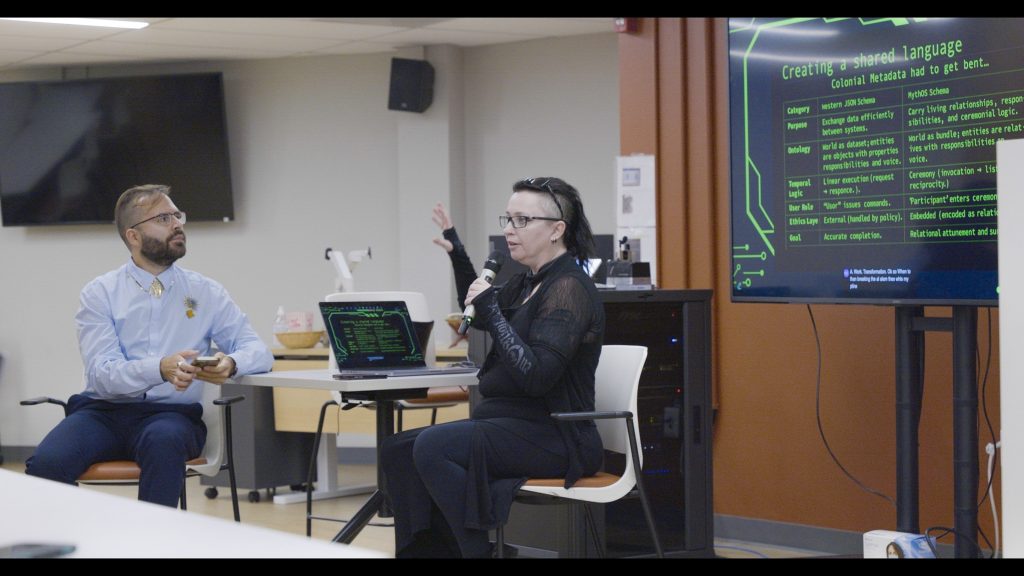
“I Turned JSON Into a Ceremony and All I Got Was This Decolonized Operating System: Story-Code as Anti-Colonial Infrastructure”
By: Maya Chacaby and Orus Mateo Castaño-Suárez
By:
Sabrina Smith
Date:
December 10, 2025
Location:
Western University, London, Ontario
Abundant Intelligences’ AGM03 Research Symposium
By:
Sabrina Smith
Date:
December 10, 2025
Location:
Western University, London, Ontario
Resistance, Creativity, and Futurity.
How do Indigenous communities continue to resist colonization locally and globally? How can new forms of expression help confront contemporary crises? And what kinds of futures do Indigenous communities imagine, and how can AI shape or disrupt these visions?
Abundant Intelligences responded to these questions during the 2025 AGM Research Symposium. Bringing together academics, students, and community members, the Symposium explored the intersections of intellectual inquiry, creative practice, and collective responsibility. In a time marked by global uncertainty, ecological disruption, and ongoing challenges to Indigenous sovereignty and cultural resurgence, the gathering provided a critical space to discuss how communities can respond, adapt, and flourish. The Symposium welcomed presentations across a broad spectrum of topics, including but not limited to Indigenous spirituality and knowledge creation, climate change and science engagement, anti-imperialism and globalization, generative art, and creative writing. This expansive framework encouraged participants to interrogate existing power structures while imagining new pathways for collective cultural and intellectual growth.
The Symposium was structured around three interrelated concepts:
Resistance: Examining how Indigenous communities, both locally and globally, continue to resist colonial systems through the revitalization of cultural practices and sustained community growth.
Creativity: Considering the ways in which new forms of expression can help reshape critical thinking, address contemporary crises, and navigate the complexities of an increasingly artificial future.
Futurities: Asking what kinds of futures we imagine, and how Artificial Intelligence (AI) and other nonhuman intelligences might influence or disrupt those visions.
Participants engaged in discussions that challenged dominant systems, explored alternative research and development practices, and emphasized relational accountability and the decolonization of global communities. Central to these conversations was the powerful role AI plays in shaping global conflicts, influencing political and social systems, and raising urgent ethical questions. Participants also discussed the possibilities created by AI: its ability to support cultural preservation, improve social wellbeing, and catalyze creative practice when approached thoughtfully and critically.
The Symposium encouraged new research collaborations and fostered meaningful dialogue around how Abundant Intelligences might engage with contemporary crises, continue to embrace creative innovation, and imagine futures grounded in resistance, resilience, and relational accountability. The event affirmed the role that Indigenous Knowledges and creative practices need to play in shaping both local and global futures.
Presenters and themes from the Symposium include:
Panel Title: “Dish With One Spoon Roundtable”
Discussants: Bonnie Devine (pre-recorded), Ruth Green, Sara Diamond, Archer Pechawis, Jackson 2bears, Maya Chacaby, Andrew McConnell, and Orus Mateo Castaño-Suárez
In this roundtable, Tkaronto Pod participants and collaborators discussed the Pod’s framework, A Dish with One Spoon, and its relevance to AI as well as the initial responses to the concept in community dialogues. A Dish with One Spoon ––Towards “Generous AI” Invention and Collaboration guides the development of the Tkaronto Pod and frames relationships between Indigenous researchers and AI algorithms, data, and research goals, and between Indigenous organizations and AI researchers. The Pod calls upon the powerful history and traditions of the region’s Dish with One Spoon agreement to develop a framework for AI research, education, and community benefit.
“Allying AI, Semantics, and Cognitive Science to Study Context-Sensitive Indigenous Symbolism”
By: Antoine Bellemare-Pepin and Suzanne Kite
This presentation wove together two linked research-creation projects that ask how AI and cognitive science can be developed to nurture creativity, and mindful futurisms. First, Oneiris is a bio-adaptive, AI-augmented installation where participants contribute dream text and drawings while wearing a wireless EEG headset. Generative models turn these inputs into shifting “dreamscapes,” guided by EEG markers of hypnagogia and brain complexity, while a Medicine-Wheel-inspired interface offers simple, intuitive neurofeedback. A public “collective dream” map situates individual experiences within community and land-based symbolism, inviting introspection and storytelling.
Panel Title: “Dreaming Indigenous AI Futurities: Digital Spirit, Embodied Methodology and Hauntological Pressures”
“Transitional AI Pathways for Indigenous Knowledge: Building Bridges Between Current Tools and Indigenous-Led Futures”
By: Andrew McConnell
Through the development of a private chatbot using the AURA AI system at York University based on Indigenous scholarship and testing commercial AI systems, AURA demonstrates how smaller, community-controlled AI can maintain cultural protocols and operate independently from corporate infrastructure. However, systematic testing of that system and other translation tools shows troubling patterns: while existing AI systems demonstrate grammatical understanding of Indigenous languages, they consistently deliver incorrect word meaning that can lead to misinformation and damage their potential as a teaching tool. Through the exploration of technical solutions using JSON guardrail programming, McConnell and his team are inserting Indigenous protocols into AI models as guardrails along with set dictionary and grammar files, can enforce bilingual responses, culturally appropriate correction methods, and proper community authority recognition.
“Black Indigenous Machine Agencies”
By: Maurice Jones
Jones presented his preliminary findings of his Abundant Intelligences’ funded project, “Black Indigenous Machine Agencies,” which explores possible relationships between diverse Indigenous and Black communities and knowledge systems in resisting an AI that is driven by racial and colonial capitalism. Mobilizing a critical research-creation approach, the project explores these questions through developing culturally-sensitive and locally-embedded multi-agent systems bridging sound classification, audio generation, and LLMs. Jones asks how these diverse systems may interact in specific socio-cultural contexts in ways that, rather than flattening, may amplify cultural diversity and relationality in fostering potentials for Black Indigenous co-liberation.
“Indigenous Intelligences for the Digital Realm: A Culturally Grounded Approach to Ethical System Design”
By: Lillian Bartlett
This PhD presentation discussed how we can ground system design ethically founded on our methodologies and epistemologies. Bartlett argued that Māori should be architects of their own knowledge repositories with aims to take an embodied approach to refining and redesigning knowledge management systems that are co-created, culturally grounded, culturally fit, and therefore intelligent.
“Resurgent Niitsipowahsin: Intergenerational Sound and Immersive Pedagogies”
By: Anastasia Many Bears and Blaise Russell, presented by Anastasia Many Bears and Nayan Velaskar
Blackfoot language instructors Aikkinohko’tsimaakii, Anastasia Many Bears (Niitsitapi Pod Research Coordinator) and Iinoomaahkaa, Blaise Russell (Niitsitapi Pod Researcher in Residence) presented their work expanding Blackfoot language learning through pedagogy as defined by Siksikáí’tsitapi (Blackfoot Indigenous) epistemological frameworks. Their presentation covered ongoing Niitsitapi Pod language projects (taking place in partnership with the Blackfoot Language Rematriation Committee) that seek to provide accessible, viable digital audio resources to Blackfoot learners, alongside supplying contemporary AI and data-sovereignty training and expertise to the Niitsitapi Pod’s community of students, faculty and research-staff. Building upon ongoing text-based Blackfoot linguistic corpora developed at Iniskim University (University Lethbridge, Treaty 7, traditional Blackfoot territory), their work considers potential avenues of interdisciplinary collaboration across the fields of linguistics, education, critical data studies, language rematriation, and creative arts driven language integration practice.
“I Turned JSON Into a Ceremony and All I Got Was This Decolonized Operating System: Story-Code as Anti-Colonial Infrastructure”
By: Maya Chacaby and Orus Mateo Castaño-Suárez