2RO Media Festival 2025
Transmitting cultural knowledge through digital art and creative practices.
Where can you see 3D artistically rendered biomolecules and a digital Haudenosaunee Wampum while listening to PowWow Step, a fusion of Indigenous PowWow and Electronic music? The 2RO Media Festival. This annual event features media arts installations, film and video, audio projects, performance, spoken word and artists’ panels/talks in Ohsweken, on Six Nations of the Grand River. It’s hosted by 2RO Media, a Haudenosaunee-led artist and curatorial collective that’s been shaping stories, spaces, and experiences since 2015. Co-directed by January Rogers and Jackson 2Bears, 2RO Media is 100% Haudenosaunee-led and dedicated to supporting Indigenous projects, productions, cultural activities, and language revitalization with a special focus on Six Nations artists, performers, and creators.
From October 3-5, 2025, Abundant Intelligences artists and researchers showcased prototype artworks, practice-based projects, and digital technologies. These creative pieces reflect Abundant Intelligences’ core methodological approach, which employs mixed methodologies interweaving research-creation, qualitative inquiry, and quantitative modes of knowledge production, all grounded in Indigenous research frameworks. Each of these works draws upon Indigenous Knowledge Systems to develop imaginations, frameworks, and languages that transform human relationships to technology, the environment, and each other.
Check out our featured presenters and their works below:
KAHIONHAKTÀ:TYE | OTEKH LABS PROJECT | Haudenosaunee Pod
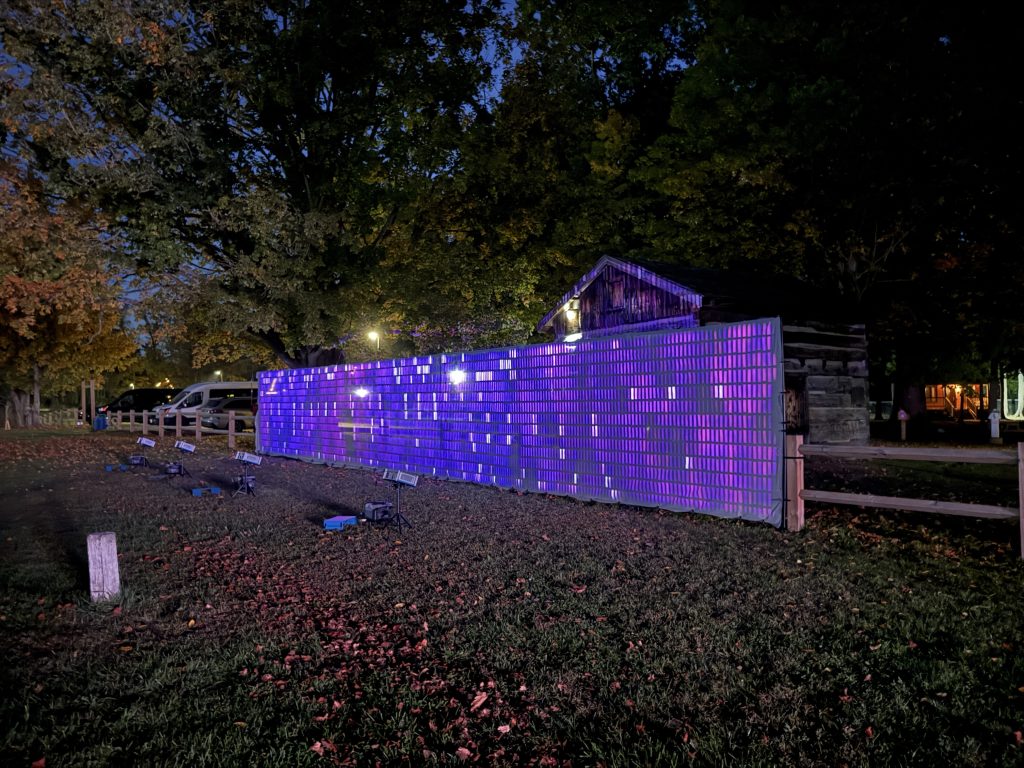
KAHIONHAKTÀ:TYE is a prototype artwork exploring the intersections of wampum—as a living cultural form—and contemporary digital technologies. Rooted in Haudenosaunee traditions of wampum as a medium of diplomacy, memory, and relational knowledge, the work engages with AI, machine learning, and emerging media as extensions of land-based forms of intelligence. It positions technology within a larger interconnected ecosystem where digital systems, ancestral knowledge, and environmental processes inform one another. The prototype takes the form of a digital wampum composition, drawing on bead-like video patterns and generative processes that are guided by both archival knowledge and real-time environmental data (taken from sensors along the Grand River). These data streams act not as abstract numbers but as expressions of the land and its intelligences—water, wind, temperature, ebb and flow—translated into the visual and sonic registers of the artwork. In this way, the wampum prototype becomes not just a representation of knowledge but a dynamic interface between human, nonhuman, and more-than-human forms of intelligence. As part of a larger ecosystem of ongoing research-creation, KAHIONHAKTÀ:TYE contributes to developing methods for relational AI—systems that acknowledge the reciprocity between cultural protocols, land-based teachings, and digital infrastructures. This ecosystem includes experimental projects with VR, sensors, archives, and community-driven data sovereignty frameworks. The wampum prototype is an early step in imagining how technologies might be designed not simply as tools, but as participants in a broader network of responsibilities and relationships.
TRANSMUTTING ENERGIES | WALKER ENGLISH | Niitsitapi Pod
Transmuting Energies emerges from the idea that energy is always in flux and that energy can be transmuted or changed by the individual. Transmuting Energies seeks to transmute negative energies brought on through colonization into something positive and generative. The project incorporates Blackfoot iconography such as petroglyphs and pictographs. Several large-scale canvases use collage as the main technique to present various pictographs, petroglyphs, Blackfoot history, culture, and language. Present and historical Blackfoot struggles against Canadian colonialism are also a central theme in the canvases. The project will continue to expand, implementing AI and other emerging technologies to create interactive art installations. By implementing these emerging technologies, English hopes to reach wider audiences, continue to develop and widen his own art practice, and demonstrate the ever-changing flux that is always present. Transmuting Energies reclaims and revitalizes Indigenous Knowledge Systems through tools that have historically been used to suppress them. It also challenges dominant narratives around technology by asserting that Indigeneity and innovation are not opposing forces, but rather deeply interconnected.
DANCING MOLECULAR LANDSCAPES | SJ OKEMOW | Tkaronto Pod
SJ’s practice-based project offers a critical re-examination of the aesthetic practices of biomolecular visualization, reframing these questions through a decolonial lens to ask what new visual aesthetics are possible to represent emergent, non-linear, and interconnected molecular and cellular events. This work thinks critically about Western science narratives of objectivity and seeks to embed SJ’s identity as a Nêhiyaw woman, as well as their lived experience with autoimmune illnesses and disorders, into the process.
By:
Sabrina Smith
Date:
December 10, 2025
2RO Media Festival 2025
By:
Sabrina Smith
Date:
December 10, 2025
Transmitting cultural knowledge through digital art and creative practices.
Where can you see 3D artistically rendered biomolecules and a digital Haudenosaunee Wampum while listening to PowWow Step, a fusion of Indigenous PowWow and Electronic music? The 2RO Media Festival. This annual event features media arts installations, film and video, audio projects, performance, spoken word and artists’ panels/talks in Ohsweken, on Six Nations of the Grand River. It’s hosted by 2RO Media, a Haudenosaunee-led artist and curatorial collective that’s been shaping stories, spaces, and experiences since 2015. Co-directed by January Rogers and Jackson 2Bears, 2RO Media is 100% Haudenosaunee-led and dedicated to supporting Indigenous projects, productions, cultural activities, and language revitalization with a special focus on Six Nations artists, performers, and creators.
From October 3-5, 2025, Abundant Intelligences artists and researchers showcased prototype artworks, practice-based projects, and digital technologies. These creative pieces reflect Abundant Intelligences’ core methodological approach, which employs mixed methodologies interweaving research-creation, qualitative inquiry, and quantitative modes of knowledge production, all grounded in Indigenous research frameworks. Each of these works draws upon Indigenous Knowledge Systems to develop imaginations, frameworks, and languages that transform human relationships to technology, the environment, and each other.
Check out our featured presenters and their works below:
KAHIONHAKTÀ:TYE | OTEKH LABS PROJECT | Haudenosaunee Pod
KAHIONHAKTÀ:TYE is a prototype artwork exploring the intersections of wampum—as a living cultural form—and contemporary digital technologies. Rooted in Haudenosaunee traditions of wampum as a medium of diplomacy, memory, and relational knowledge, the work engages with AI, machine learning, and emerging media as extensions of land-based forms of intelligence. It positions technology within a larger interconnected ecosystem where digital systems, ancestral knowledge, and environmental processes inform one another. The prototype takes the form of a digital wampum composition, drawing on bead-like video patterns and generative processes that are guided by both archival knowledge and real-time environmental data (taken from sensors along the Grand River). These data streams act not as abstract numbers but as expressions of the land and its intelligences—water, wind, temperature, ebb and flow—translated into the visual and sonic registers of the artwork. In this way, the wampum prototype becomes not just a representation of knowledge but a dynamic interface between human, nonhuman, and more-than-human forms of intelligence. As part of a larger ecosystem of ongoing research-creation, KAHIONHAKTÀ:TYE contributes to developing methods for relational AI—systems that acknowledge the reciprocity between cultural protocols, land-based teachings, and digital infrastructures. This ecosystem includes experimental projects with VR, sensors, archives, and community-driven data sovereignty frameworks. The wampum prototype is an early step in imagining how technologies might be designed not simply as tools, but as participants in a broader network of responsibilities and relationships.
TRANSMUTTING ENERGIES | WALKER ENGLISH | Niitsitapi Pod
Transmuting Energies emerges from the idea that energy is always in flux and that energy can be transmuted or changed by the individual. Transmuting Energies seeks to transmute negative energies brought on through colonization into something positive and generative. The project incorporates Blackfoot iconography such as petroglyphs and pictographs. Several large-scale canvases use collage as the main technique to present various pictographs, petroglyphs, Blackfoot history, culture, and language. Present and historical Blackfoot struggles against Canadian colonialism are also a central theme in the canvases. The project will continue to expand, implementing AI and other emerging technologies to create interactive art installations. By implementing these emerging technologies, English hopes to reach wider audiences, continue to develop and widen his own art practice, and demonstrate the ever-changing flux that is always present. Transmuting Energies reclaims and revitalizes Indigenous Knowledge Systems through tools that have historically been used to suppress them. It also challenges dominant narratives around technology by asserting that Indigeneity and innovation are not opposing forces, but rather deeply interconnected.
DANCING MOLECULAR LANDSCAPES | SJ OKEMOW | Tkaronto Pod
SJ’s practice-based project offers a critical re-examination of the aesthetic practices of biomolecular visualization, reframing these questions through a decolonial lens to ask what new visual aesthetics are possible to represent emergent, non-linear, and interconnected molecular and cellular events. This work thinks critically about Western science narratives of objectivity and seeks to embed SJ’s identity as a Nêhiyaw woman, as well as their lived experience with autoimmune illnesses and disorders, into the process.